

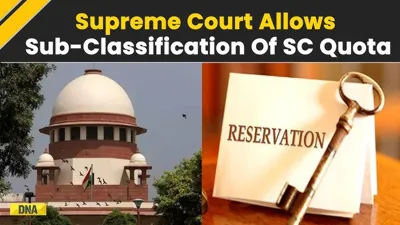
Supreme Court of India's Landmark Judgement on SC/ST Quota Sub-classification
| Aspect | Details |
|---|---|
| Event Date | August 1, 2024 |
| Court | Supreme Court of India |
| Bench | Seven-Judge Bench |
| Judgement | Landmark judgement on Scheduled Castes (SC) and Scheduled Tribes (ST) quota |
| Opinions | Six separate opinions, five in favor of sub-classification, one dissent by Justice Bela Trivedi |
| Historical Context | Reservations introduced in the Constitution in 1950 |
| Article 341 | Allows the President to list castes, races, or tribes as SCs, providing 15% reservation in education and public employment |
| Key Judicial Cases | 1975 Punjab Notification, E V Chinnaiah (2004), Davinder Singh v State of Punjab (2020) |
| 2020 Ruling | Reconsideration of E V Chinnaiah, acknowledging "unequals within the list of Scheduled Castes" |
| Key Issues | 1. Uniform treatment of SCs, 2. States' power to sub-classify SC list, 3. Yardstick for sub-classification, 4. Application of 'creamy layer' principle to SCs |
| Majority Opinion | States can identify degrees of social backwardness and provide special provisions; stringent guidelines for sub-classification |
| CJI Chandrachud's Verdict | Rejected uniform treatment of SCs, emphasized "effective representation" over "numerical representation" |
| Creamy Layer Principle | Supported by Justice Gavai and four other judges |