

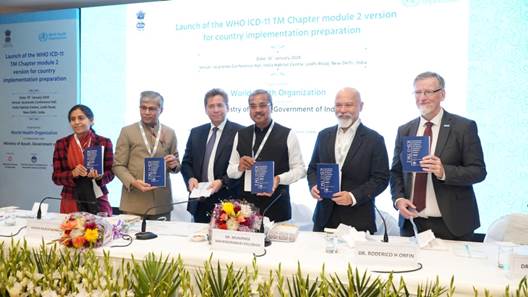
Launch of the Traditional Medicine Morbidity codes of Ayurveda, Siddha and Unani Chapter
- The World Health Organization (WHO) and the Ministry of Ayush are set to launch the ICD 11 TM Module 2, Morbidity Codes, event in New Delhi
- This initiative aims to integrate data and terminology related to diseases based on Ayurveda, Siddha, and Unani systems into the WHO's International Classification of Diseases (ICD) series.
Key Developments
Global Uniformity in ASU Medicine
- Inclusion of Ayurveda, Siddha, and Unani data in ICD11 for global uniformity.
- Establishing a universal code of vocabulary to define diseases in ASU medicine.
CBHI's Role and Ayush Code Development
- Central Bureau of Health Intelligence (CBHI), under the Ministry of Health, is WHO Collaboration Centre for ICD activities.
- Ministry of Ayush developed Ayurveda, Siddha, and Unani Medicine codes through NAMSTE portal.
Donor Agreement and Strengthening Public Healthcare:
- The Ministry of Ayush signed a Donor Agreement with WHO.
- This collaboration aims to enhance India's public healthcare delivery, research, Ayush insurance coverage, and policy-making systems.
Inclusion of Traditional Medical Diseases
- Codes to be used in controlling diseases and formulating future strategies.
- Other WHO member countries express willingness to adopt a similar approach.
Disease Classification Examples
- Traditional diseases like infectious diseases (e.g., Malaria) and lifestyle diseases (e.g., chronic insomnia) included.
- Specific examples from Ayurveda, Siddha, and Unani for disorders like Vertigo Guidance Disorder.
Prelims Takeaway
- Traditional diseases
- WHO