

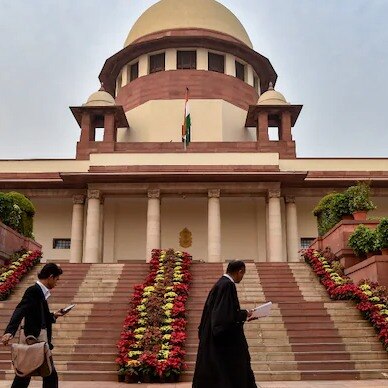
Key aspects of Article 370 verdict
- The Supreme Court, in a unanimous 5-0 ruling, upheld the Centre's abrogation of Article 370 of the Constitution.
Sovereignty of Jammu and Kashmir
- The court examined the constitutional set-up of Jammu and Kashmir to determine if it retained an element of sovereignty.
- Article 1 of the Constitution of India and Section 3 of the J&K Constitution affirmed the integration of J&K into India, refuting the argument for retained sovereignty.
- The court held that the gradual process of constitutional integration was ongoing, culminating in the declaration by the President.
Temporary or Permanent Nature of Article 370
- Arguments were made on the permanence of Article 370, with petitioners contending it couldn't be abrogated due to its permanence.
- The CJI and Justice Kaul concluded that Article 370 was always meant to be a temporary provision, and its mechanism did not end with the dissolution of the J&K Constituent Assembly.
- The CJI said that there were two aspects that showed the temporary nature of Article 370.
- It was intended as an interim arrangement until the Constituent Assembly of the State was formed.
- Since in the interim, there was a need for a legal bridge between J&K and India.
- The provision was adopted because of the special circumstances in the state, which was experiencing war conditions.
- It was intended as an interim arrangement until the Constituent Assembly of the State was formed.
Legality of Abrogation
- The legal route for the abrogation of Article 370 was twofold.
- It involved issuance of CO 272 by the President, which amended Article 367 of the Constitution.
- Article 367 deals with interpretation of the Constitution.
- The CO added a new meaning to “Constituent Assembly of Jammu and Kashmir” to mean “legislative assembly of Jammu and Kashmir.
- CO 273 was promulgated seeking the consent of Parliament to recommend that “all clauses of the said article 370 shall cease to be operative”.
- Justice Kaul upheld this process, while CJI Chandrachud suggested that changing the meaning of the Constituent Assembly of J&K was unnecessary.
- The President could have unilaterally abrogated Article 370.
Action during President's Rule
- The court referred to the 1994 Bommai ruling to decide the validity of actions during the President's rule.
- The standard for validity was whether the action was not ‘mala fide or palpably irrational’, and if ‘advisability and necessity of the action was not borne in mind by the President”.
- The court also held that the petitioner and the Union government must show mala fides to the court.
- The ruling rejected the argument that irrevocable action being taken cannot be accepted as proof of mala fides.