

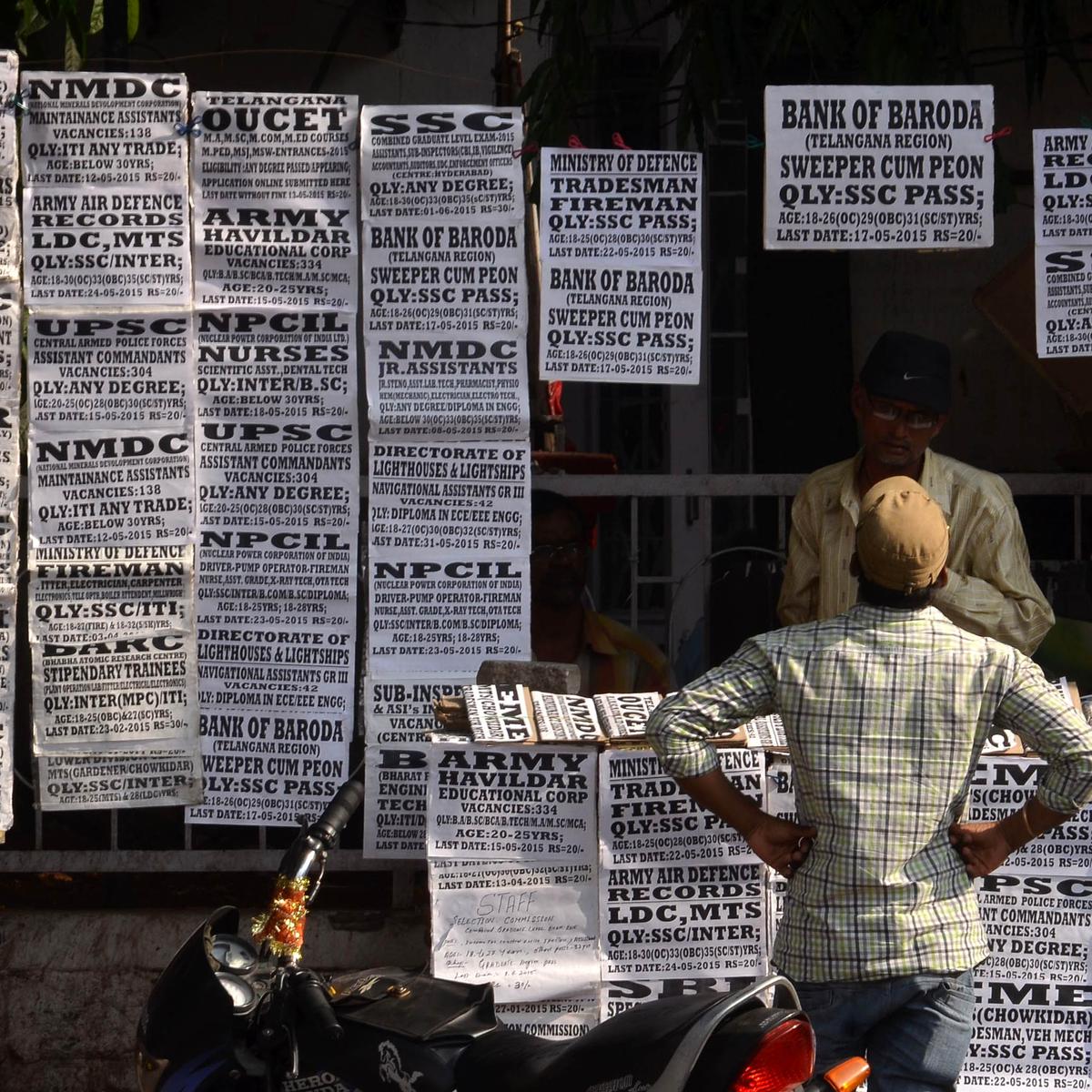
Joblessness rising in country with education levels: study
- According to a study by IIM Lucknow, India’s economy is witnessing a stagnating employment growth, weakening employment elasticity and slow structural transformation.
- Additionally, structural problems are brewing in the labour market such as low female labour force participation and a rise in the unemployment rate (UR) with education levels.
Trends in Employment Growth
- Surge in output and employment from 1987-88 to 2004-05, followed by 'jobless growth' from 2004-05 to 2018-19, and a minimal rebound afterward.
- Agricultural sector, though employing the most youth, contributed low value-added to the overall economy, resulting in significant employment challenges.
- Economic growth hasn't translated into job creation and has rather resulted in net labour displacement.
Policy Recommendations for Growth
- The study suggests identifying and promoting the labour-intensive manufacturing sector to achieve inclusive growth.
- Additionally, examining the quality and decency of jobs alongside job quantity is important.
- As there is a strong linkage between productivity and job decency.
Education Levels in Labour Market
- There is a significant gender disparity in the labour market and a growing level of unemployment for the highly educated youth than the less educated.
- In 2020–21, the total labour force in India stood at an estimated 556.1 million.
- Out of this total, 292.2 million (54.9%) were self-employed, 22.8% were in regular employment and an estimated 22.3% were in casual employment.
- The UR for the illiterate and less educated class (below primary) was 0.57% and 1.13% respectively.
- But for the highly educated class (graduates and above), it was 14.73% in 2020–21 for the age group ‘15–29 years’.
Gender Disparity in Labour Market
- There is a persistence of gender-based disparity in the Labour Force Participation Rate (LFPR) in rural and urban areas.
- Additionally, the decline of LFPR is higher for females as compared to males from 1983 to 2020-21.
- The overall female Work Force Participation Rate (WFPR) for those aged 15–59 in 2020–21 stood at 32.46%, a full 44.55 percentage points below that of men.
- Further, the total percentage of male WFPR (81.10%) in the same year for aged 15–59 years is more than twice the rate for female adults (33.79%).
Impact of Public Policies
- Mahatma Gandhi National Rural Employment Guarantee Act (MGNREGA) and similar initiatives have positive effects on rural livelihoods.
- These policies raise wages, increase female labour force participation and improve bargaining power among low-caste workers.
Prelims Takeaway
- MGNREGA
- Unemployment
- Labour Force Participation Rate