

HOW CLIMATE CHANGE IS BRINGING BACK THE IDEA OF AIRSHIPS
- Airships were the first aircraft capable of controlled powered flight and were thought to be the future of travel for some years in the early 20th century. However, fundamental technological shortcomings and the rapid development of aeroplanes killed the idea of airship transport.
Highlights:
- Airships were the first aircraft capable of controlled powered flight and initially seemed to be the future of travel in the early 20th century. However, limitations in technology and the rapid advancement of airplanes led to a decline in airship use.
- Today, airships have limited roles, mostly for advertising, scientific observation, military surveillance, and tourism.
The Buoyancy Challenge for Cargo Transportation:
- Basic Working Principle: Airships operate as lighter-than-air aircraft, lifted by gases like helium, which are less dense than atmospheric gases, similar to the concept in helium balloons.
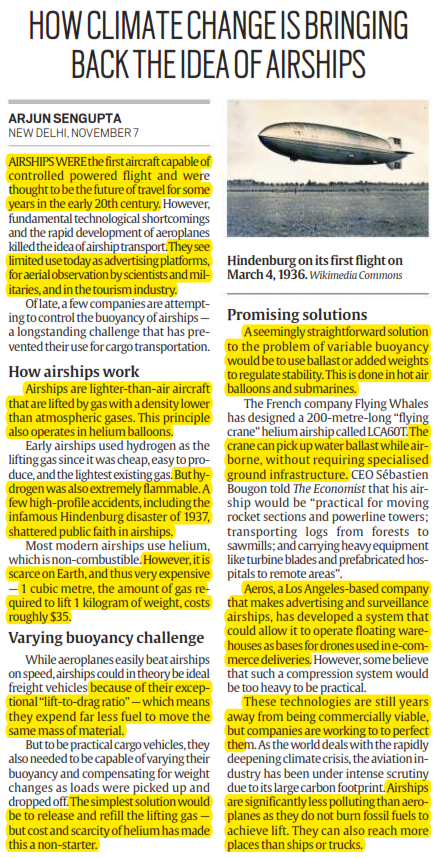
- Historical Issues with Hydrogen: Early airships used hydrogen for lift due to its low cost and availability. However, hydrogen is highly flammable, and catastrophic incidents, including the Hindenburg disaster, led to its decline.
- Switch to Helium: Modern airships use non-combustible helium, but it is scarce and expensive, costing around $35 per cubic meter. This high cost makes it impractical to release and refill helium for weight management, which is a challenge for airships used in cargo transport.
Varying Buoyancy: The Core Hurdle:
- Lift-to-Drag Advantage: Airships have an excellent lift-to-drag ratio, making them fuel-efficient compared to airplanes, thus theoretically ideal for freight.
- Problem of Variable Buoyancy: For airships to function as cargo vehicles, they must adjust their buoyancy as weight changes when picking up or dropping off loads. Simply releasing helium is not a feasible option due to cost and scarcity.
- Innovative Solutions Under Development
Using Ballast for Stability:
- Some companies are looking to adopt a ballast system to manage buoyancy, similar to the approach used in submarines and hot air balloons.
- Flying Whales, a French company, has developed a 200-meter "flying crane" airship, the LCA60T. This design allows the airship to pick up water as ballast mid-air, eliminating the need for specialized ground infrastructure. According to CEO Sébastien Bougon, this airship could transport large items like rocket parts, logs, turbine blades, and prefabricated hospitals to remote locations.
Compressed Helium Systems for Floating Warehouses:
- Aeros, a Los Angeles-based company specializing in advertising and surveillance airships, is working on a system to compress helium for a variable buoyancy mechanism. Their idea involves floating warehouses that could serve as bases for drone deliveries in e-commerce.
- However, there is skepticism about whether such compression systems would be too heavy for practical use, which remains a challenge for feasibility.
Future Outlook and Environmental Benefits:
- Though these technologies are still years away from being commercially viable, companies are advancing efforts to perfect them.
- Eco-Friendly Alternative: Airships are far less polluting than airplanes, as they don’t burn fossil fuels to achieve lift. Given the aviation industry's carbon footprint, airships present a potential solution for more sustainable transport, particularly for reaching locations inaccessible by ships or trucks.
Prelims Takeaways
- Hindenburg disaster of 1937