

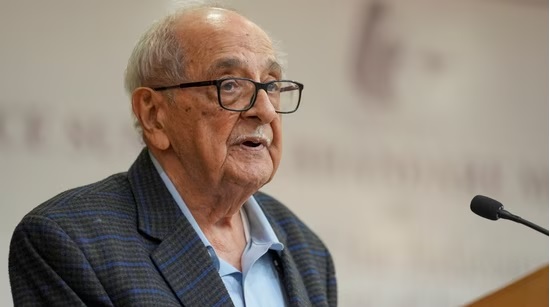
Fali S Nariman: 9 notable cases of the late jurist
- Recently, eminent jurist and Senior Advocate Fali S Nariman passed away at the age of 95.
- His career as a lawyer spanned over 75 years with the last half-century being spent as a senior advocate of the Supreme Court of India.
- During this time, he left an imprint on the law and the legal profession in a vast array of landmark cases.
Notable Cases
- The Second Judges Case: Supreme Court Advocates-on-Record Association v. Union of India
- He played a pivotal role in challenging a Supreme Court ruling that granted the central government final authority in matters regarding judicial appointments and transfers.
- He argued that the consultation process between the Chief Justice of India (CJI) and the President must be more than mere advice-seeking to ensure judicial independence.
- His efforts led to the establishment of the Supreme Court Collegium in 1993, ensuring binding recommendations for appointment of judges to the apex court and High Courts.
- The Third Judges Case
- The President of India under Article 143 of the Constitution asked for clarification on the procedure for appointment of judges following the second judges case.
- He clarified that the CJI must consult other judges of the Supreme Court before making any recommendations for judicial appointments.
- This case also expanded the size of the Supreme Court Collegium to five senior most judges from the existing three
- National Judicial Appointments Commission case: Supreme Court Advocates-on-Record Association v. Union of India
- He continued his advocacy for judicial independence during the challenge against the National Judicial Appointments Commission Act, 2014 (NJAC).
- The NJAC amended the Constitution to insert Article 124A which created a six-person commission for judicial appointments.
- This commission would comprise
- The Chief Justice of India
- Two other senior SC Judges
- The Union Minister of Law and Justice
- Two “eminent persons” who would be nominated by a committee comprising the CJI
- The Prime Minister
- The Leader of Opposition.
- He asserted that it would compromise judicial independence by involving the central government and legislature in judicial appointments.
- The Supreme Court agreed with his stance and struck down the NJAC in 2015, reaffirming the collegium system.
- Parliament cannot curtail fundamental rights: I.C. Golak Nath v. State of Punjab
- He intervened in the I.C. Golak Nath case (1967), arguing against Parliament's power to curtail fundamental rights through constitutional amendments.
- His efforts contributed to the court's ruling that Parliament cannot amend articles related to fundamental rights, safeguarding the core principles of the Constitution.
- Bhopal gas tragedy: Union Carbide Corporation v. Union of India (1989)
- In 1984, in the Bhopal gas tragedy, 42 tons of toxic chemicals leaked from a pesticide plant owned by Union Carbide India Limited.
- This resulted in thousands of deaths and environmental damage in the following years.
- In the aftermath of the tragedy, he represented Union Carbide and negotiated a settlement with the government, securing compensation for the victims.
- Rights of minorities to establish and administer education institutions: TMA Pai Foundation v. State of Karnataka
- He argued in the landmark TMA Pai case in support of minority rights to establish and administer educational institutions under Article 30(1) of the Constitution.
- The court held that linguistic and religious minorities have to be determined on a state-by-state basis.
- Additionally, the government has the power to frame regulations which will apply to minority-run educational institutions.
- However, these regulations cannot destroy the minority character of the institution.
- Governor to act only upon the aid and advice of the council of ministers, chief minister: Nabam Rebia, and Bamang Felix v. Deputy Speaker
- He played a crucial role in resolving a political crisis in Arunachal Pradesh following the rebellion of 21 MLAs in 2015.
- He asserted that the governors must act upon the aid and advice of the council of ministers and chief ministers.
- His legal intervention restored the constitutional order in the state.
- Cauvery Water Dispute: State of Karnataka v State of Tamil Nadu
- For over three decades, he represented Karnataka in the Cauvery water dispute with Tamil Nadu.
- Due to the non-compliance, he refused to argue the case on behalf of the Karnataka government any further.