

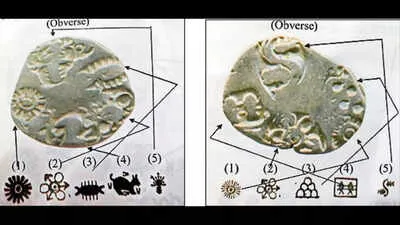
Dark Age Coins Unearthed in Rajasthan Shed Light on Ancient Trade
| Aspect | Details |
|---|---|
| Event | Dark Age Coins Unearthed in Rajasthan |
| Time Period | 600 BC-1000 BC |
| Significance | Provides insights into the "Dark Age" between the decline of Indus Valley Civilization and the era of Lord Buddha (1900 BC-600 BC). |
| Key Discoveries | Punch-mark coins found in Rajasthan, sites include Ahar (Udaipur), Kalibanga (Hanumangarh), Viratnagar (Jaipur), and Jankipura (Tonk). |
| Coin Details | Coins made of silver and copper, weighing 3.3 grams, with symbols like Sun, Shadchakra, and Mountains/Meru. |
| Major Findings | 3,300 coins unearthed in Tonk (1935), 2,400 coins in Sikar (1998), and metallurgical tools resembling those in Maharashtra, Tamil Nadu, and Peshawar. |
| Historical Records | Chinese travelers Fa-Hien (399-414 CE), Sunyan (518 CE), and Hiuen-Tsang (629 CE) documented ruins in Rajasthan. |
| Trade & Cultural Links | Rajasthan's trade history parallels the Silk Route, with coins from Gupta dynasty, Malavas, and Janapadas found. |
| Treasure Collection | Rajasthan Department of Archaeology has over 2.21 lakh ancient coins, including 7,180 punch-marked examples. |
| Indus Valley Civilization | Flourished around 2,500 BC, declined around 1800 BCE due to climate change and migration. Discovered in the 1920s by John Marshall. |
| Key Sites of Indus Valley | Mohenjo-Daro and Harappa were major cities. Harappa is often associated with the civilization's name. |