

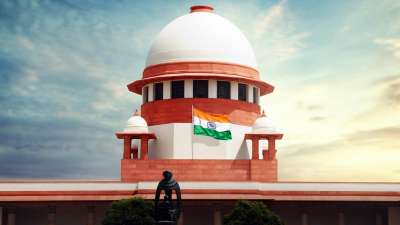
Court reserves verdict: debate around sub categorisation within SC quota
- Recently, a seven-judge Constitution Bench, led by the Chief Justice of India, reserved judgement in a case concerning sub-classification among Scheduled Castes (SCs).
- This arises from states' arguments that, despite reservation, some castes are grossly underrepresented and need separate quotas.
E.V. Chinnaiah v State of Andhra Pradesh Case, 2004
- The five-judge Constitution Bench ruled that only the President could determine which communities could receive reservation benefits under Article 341, barring states from altering this list.
- The states contested the Chinnaiah decision, asserting their authority to ensure fair distribution of reservation benefits.
The Beginning
- The Punjab government's attempt to sub-classify SCs, favouring certain communities, was struck down by the courts.
- The court held that the sub-classification would violate the right to equality by treating communities within the category differently.
- The SC list must be treated as a single, homogenous group, since the Constitution classifies certain castes in a Schedule as they historically faced discrimination due to untouchability.
Appeal and Reevaluation
- In October 2006, the Punjab government attempted to bring back the law by passing the Punjab Scheduled Caste and Backward Classes (Reservation in Services) Act, 2006.
- In 2010, the High Court once again struck down this provision, and the Punjab government then moved the Supreme Court.
- The case was referred to a five-judge Constitution Bench in 2014 ('Davinder Singh v State of Punjab'), questioning the Chinnaiah ruling.
- In 2020, this Bench held that the decision required reconsideration due to evolving interpretations of equality and the recognition of 'creamy layer' within SCs.
Arguments and Implications
- States argued that sub-classification aligns with the 'creamy layer' concept, ensuring benefits reach the most disadvantaged.
- In the landmark 2018 ruling in ‘Jarnail Singh v Lachhmi Narain Gupta’, the Supreme Court upheld the concept of “creamy layer” within SCs too.
- However, opponents assert that all SCs face historical discrimination and should be treated equally.
- The Bench, acknowledging the need to prevent political influence on reservation policies, is set to lay down criteria for fair allocation of reservations.