

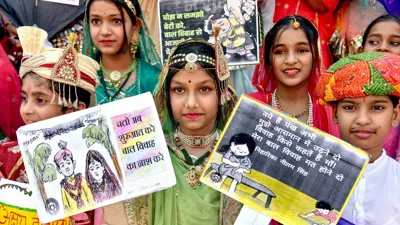
Birhor Tribe Joins Movement Against Child Marriage in Jharkhand
| Topic | Details |
|---|---|
| Event | Birhor Tribe Joins Movement Against Child Marriage |
| Location | Jharkhand, India (specifically Giridih district) |
| Tribe | Birhor, a particularly vulnerable tribal group (PVTG) |
| Community Characteristics | - Semi-nomadic - Forest-dependent - Economically and socially marginalized - Divided into two groups: Uthlus (wandering) and Janghis (settled) |
| Physical Appearance | Short stature, long heads, wavy hair, broad noses |
| Language | Similar to Santali, Mundari, and Ho |
| Religion | Combination of animism and Hinduism (Sun God, Lugu Buru, and Budhimai) |
| Economy | Primitive subsistence based on hunting, gathering, and rope-making from vine fibers; some practice agriculture |
| Initiative | First-time participation in a movement against child marriage |
| Awareness Drive | Organized by Just Rights for Children Alliance (JRC) in collaboration with Banvasi Vikas Ashram |
| Government Campaign | Part of the 'Bal Vivah Mukt Bharat' campaign by the Union Ministry of Women and Child Development |
| Key Activities | - Candlelight gatherings - Collective pledge to end child marriage - Discussions on legalities and consequences of child marriage |
| Impact | JRC claimed to have stopped over 7,000 child marriages in Jharkhand between April and December 2024 |
| High-Prevalence Districts | Jamtara, Deoghar, Godda, Giridih, Koderma, and Dumka |