

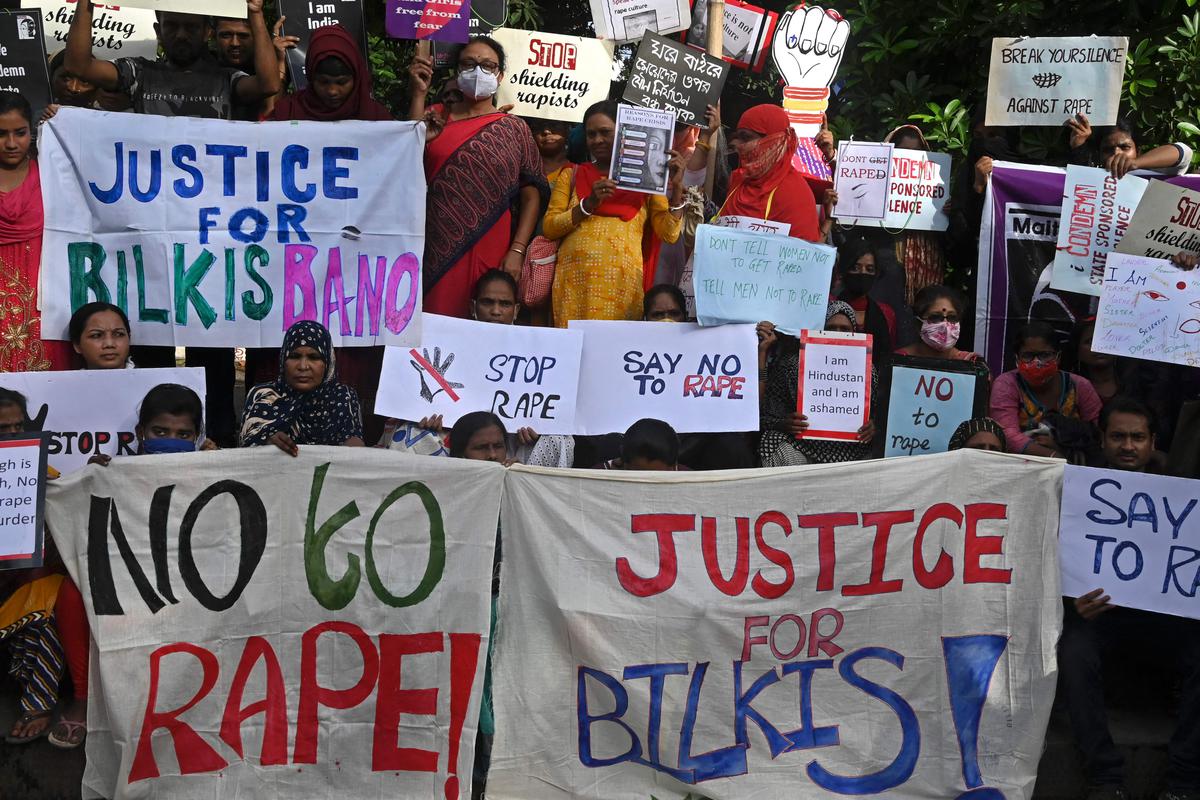
The laws around remission policy
- The Supreme Court recently overturned the remission of life sentences for 11 convicts involved in the gang rape of Bilkis Bano and her family's murder during the 2002 Gujarat communal riots.
- The remission was granted by the Gujarat government in August 2022.
Clemency Powers
- Article 72 and 161 of the Constitution empower the President and Governor to grant pardon, commutation, remission, respite, or reprieve to a convict.
- State governments, under Section 432 of the Criminal Procedure Code, 1973 (CrPC) may also remit sentences.
- In case of life imprisonment convicts, this remission can be done only after a period of 14 years in jail as per Section 433A of the CrPC.
Background of the Case
- The crimes for which the 11 persons were convicted occurred in Gujarat in 2002.
- However, considering the need for fair trial, these cases were shifted to Maharashtra by the Supreme Court in 2004.
- In 2022, one convict sought remission under Gujarat's 1992 policy, leading to their release in August 2022.
The Issues
- Jurisdiction and Procedure
- The CrPC specifies Maharashtra, where sentencing occurred, as the appropriate State for considering remission.
- Failure to seek the opinion of the presiding judge of the convicting court before considering the remission petition, as required by law.
- Supreme Court Precedents
- The Supreme Court in Laxman Naskar versus Union of India (2000) case outlined five grounds for remission, emphasizing societal impact.
- In Sangeet versus State of Haryana (2012), it established that life imprisonment convicts don't have an automatic right to premature release, and remission should be case-specific.
- The Union Home Ministry had issued an advisory in February 2013 prescribing that remission should not be granted in a ‘wholesale manner’.
- Policy Discrepancy
- The Gujarat government's 2014 remission policy explicitly barred remission for those convicted of rape and murder.
- However, the instant remission was granted based on the policy of 1992 (that had no such exclusions).
Supreme Court's Ruling
- The Supreme Court declared the Gujarat government inappropriate for considering the remission petition.
- The May 2022 order directing Gujarat to consider remission was deemed null and obtained through fraud and suppression of facts before the court.
- The 11 convicts were ordered to surrender before jail authorities within two weeks.
- Maharashtra was identified as the appropriate government for considering remission petitions, following established guidelines.
Conclusion
- The Supreme Court's ruling reinstates faith in the judicial system, emphasising adherence to the rule of law.
- The decision sets aside a controversial remission order, signalling the importance of considering the societal impact of heinous crimes in determining clemency.