

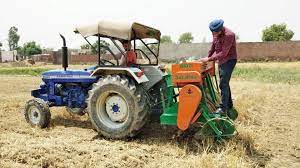
Why tractors may be the key to rural economy boost
- In India, where tractors play a central role, farm mechanisation is crucial for enhancing agricultural efficiency.
- Tractors help farmers save labour and optimise their precious time, apart from boosting crop yields.
- Policymakers are exploring reforms to promote mechanisation further, especially with emerging agricultural technologies and sustainability goals.
Current Scenario
- Tractors are vital for Indian agriculture, but only 4.6% of farmers own them, causing delays and inefficiencies in farming tasks for smallholders.
- India is, in fact, the world’s largest tractor market by volume, nearly 2.5 times of China and 3.5 of the US.
- Nearly 9.5 lakh tractors were sold domestically in 2022-23 and 4 million cumulatively in the last five years.
Government Initiatives
- Government support for agriculture has been robust through
- Investment in rural infrastructure
- Financial assistance for the purchase of machinery under the Sub-Mission on Agricultural Mechanisation (SMAC) scheme
- The government has simplified the certification process for new tractor models, reducing tests from 17 to 4.
- Moreover, the companies (manufacturers) have been permitted to self-certify these tests.
- These steps promote trust-based governance, ease of doing business, and quicker adoption of advanced technologies like precision farming.
Challenges and Reforms
- Upcoming emission standards (Bharat Stage TREM V) from April 2024 pose challenges for tractor manufacturers, requiring investments in new engine technologies.
- India needs to look beyond tractors and focus on developing farm machinery tailored for various crops and landholding sizes under the Make in India initiative.
Global Disparity
- Globally, the farm machinery industry is valued at $100 billion, with tractors contributing $60 billion.
- In India, tractor sales are $7-8 billion, while farm machinery is only $1.2 billion.
- The government can support the development of affordable, locally customized non-tractor farm machinery to align with smallholders' needs.
Industry Investments
- Significant investments in India's farm mechanisation industry are focusing on cutting-edge technologies, productivity, and sustainability.
- Import restrictions on low-quality machinery, timely subsidy disbursement, and discouraging imports from China can support industry growth.
Diversifying Tractor Usage
- Tractors have a 30% usage for non-farm activities, such as construction and transportation.
- Customising tractors for these tasks can create new avenues for rural employment.