| News Event | Uttar Pradesh becomes the first state in India to fully adopt the Government e-Marketplace (GeM) platform. |
| Key Objective | Enhance transparency and efficiency in public procurement, projected to save Rs 2,000 crore annually. |
| Previous Issues | Lack of uniformity in tendering systems, vulnerability to misuse. |
| GeM Benefits | Standardized rules, reduced violations, compliance, and accountability. |
| Demonstrated Success | Procurement for 18 Atal Residential Schools by the Uttar Pradesh Building and Other Construction Workers Welfare Board. |
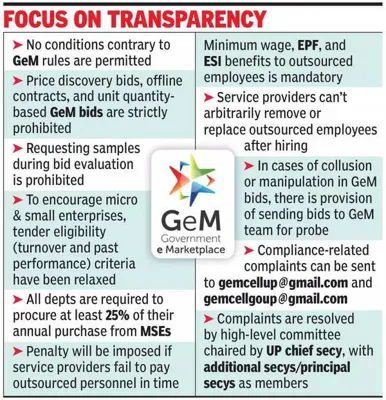
| Policy Reforms | - Prohibition of offline contracts, price discovery bids, quantity-based bids, and unnecessary sample requests. |
| - Mandatory procurement of at least 25% annual goods and services through GeM, penalties for non-compliance. |
| Support for Small Enterprises | Relaxed tender eligibility criteria for micro and small enterprises (MSEs). |
| Worker Welfare Provisions | Minimum wages, Employee Provident Fund (EPF), Employee State Insurance (ESI) benefits, job stability. |
| Anti-Collusion Measures | Severe penalties for bid manipulation, reporting mechanism to GeM team. |
| Complaint Redressal Mechanism | High-level committees chaired by the Uttar Pradesh Chief Secretary, dedicated email for grievances. |
| Alignment with National Initiatives | Promotes "Digital India" and "Make in India" initiatives through transparency and local supplier support. |
| About GeM Platform | Launched in August 2016 by the Ministry of Commerce and Industry, GeM 3.0 launched on January 26, 2018. |
| GeM Features | E-bidding, reverse e-auction, demand aggregation, aims for transparency, efficiency, and speed in procurement. |