

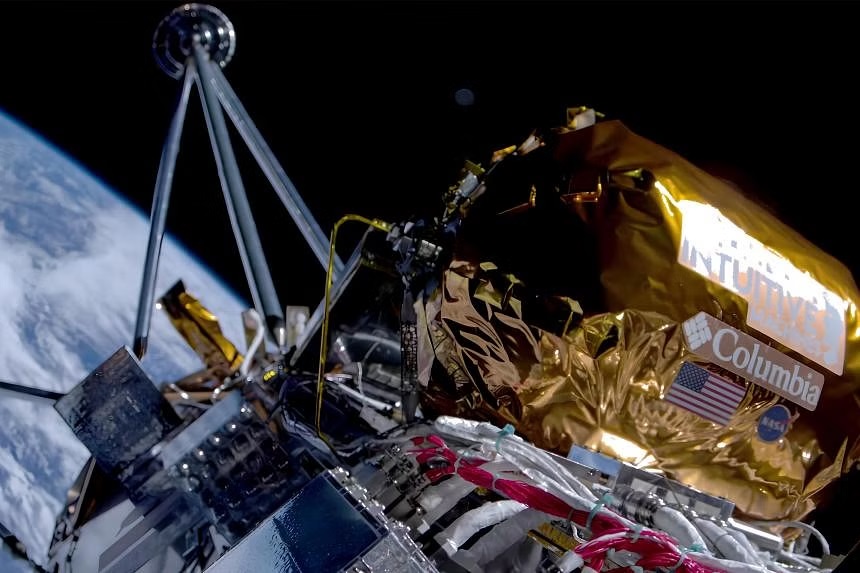
US achieves first moon landing in 50 years
- Fifty-two years after the last successful Apollo mission, a US-made spacecraft, Odysseus, landed on the Moon on February 23.
- This marked the advent of private space companies on the lunar surface.
Mission Details
- Odysseus, developed by Intuitive Machines, lifted off on a Falcon 9 rocket of SpaceX, carrying six NASA payloads to the Moon.
- The spacecraft carried six NASA payloads to the Moon.
- The lander module, Nova-C, became the second to land in the Moon’s south pole region, following Chandrayaan-3 last year.
- Funding: For this mission, NASA paid Intuitive Machines $118m under the Commercial Lunar Payload Services (CLPS) programme.
Why is it called Odysseus?
- It was named Odysseus after a contest among employees of Intuitive Machines of Houston, the company in charge of the mission.
- The name is inspired from the journey of the hero of the ancient Greek epic poem "Odyssey”.
- Odyssey's journey serves as an analogy for the long and challenging nature of the lunar mission.
Significance of the Mission
- It signifies a new phase in lunar exploration focused on establishing infrastructure and technology to support long-term human presence.
- It aims to lay the groundwork for exploiting lunar resources and fostering sustainable exploration.
- This is in contrast to past moon landings, which were primarily scientific endeavours.
- This information will help evaluate factors such as the quantity of water present and the accessibility of this vital resource.
- This is significant as NASA prepares to send a crewed mission in September 2026 with Artemis III.
Commercial Lunar Payload Services Program (CLPS)
- Under CLPS, so far, at least 14 private companies have been contracted to carry NASA payloads to the Moon.
- Objective: To create the market and technology ecosystem in the private space industry with respect to science and technology needs of lunar exploration.
Prelims Takeaway
- Odysseus
- Commercial Lunar Payload Services Program (CLPS)