

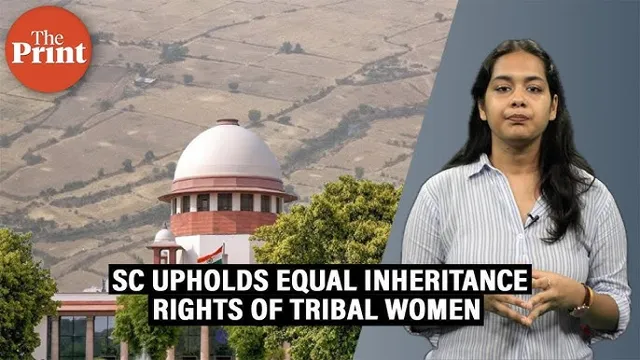
Ram Charan & Ors. vs. Sukhram & Ors
Significance: Landmark SC verdict advancing gender justice in tribal inheritance rights.
1. Key Highlights of Judgment
| Aspect | Details |
|---|---|
| Core Issue | Denial of inheritance to tribal women based on "customary law" |
| Constitutional Violation | Exclusion violates Articles 14 (equality), 15 (non-discrimination) |
| Interpretation | Read with Articles 38 (social justice) & 46 (protect tribal interests) → Gender equality is constitutional ethos |
| HSA 1956 Applicability | Though Hindu Succession Act does not apply to Scheduled Tribes, absence of law ≠ automatic exclusion of women |
| Judicial Approach | Apply justice, equity, and good conscience if no proven custom bars female inheritance |
| Precedents Cited | • Mst. Sarwango v. Mst. Urchamahin (2013): Inheritance to daughters based on equity • Tirith Kumar v. Daduram (2024): Affirmed tribal women's property rights |
2. Evolution of Tribal Women's Inheritance Rights
- Traditional customs often discriminatory
- Rights reaffirmed via Constitution (Art. 14, 15)
- Impetus from Article 46 (state duty to protect tribal interests)
- Burden of proof on those claiming "customary bar"
- Absence of statute → Courts apply equity
- Landmark shift from Madhu Kishwar v. Bihar (1996) which upheld tribal male-only inheritance
3. Custom as a Source of Law
| Aspect | Details |
|---|---|
| Definition | Unwritten practices gaining legal force through long usage & recognition |
| Essential Conditions | Ancient, continuous, reasonable, not immoral/opposed to public policy |
| Judicial Scrutiny | Customs violating fundamental rights (Art. 13) are void |
| Regressive Examples | Sati, child marriage, triple talaq (struck down in Shayara Bano v. UoI, 2017) |
| Tribal Context | Protected under Fifth Schedule but subject to constitutional morality |
**Current Affairs **
- PESA Act 1996: Empowers tribal self-governance but must align with FRs.
- Recent Step: Verdict pushes states to reform inheritance rules in Fifth Schedule areas.
- Data: STs constitute 8.6% of India’s population (2011 Census); 45% are women.