

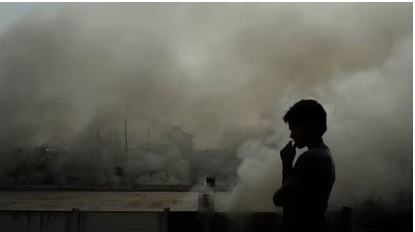
To combat climate change, citizens and government must join hands
- Air pollution, particularly in NCR (National Capital Region), remains an ongoing problem with no immediate solution in sight.
- It has evolved into a perennial concern demanding difficult choices and decisive actions, yet both society and government engage in blame games rather than substantial discussions.
Key Highlight
The Triangle Approach: Scientists, Governments, and People
- Addressing air pollution necessitates collaboration among scientists, governments, and the public.
- While scientists provide evidence, the responsibility of making informed trade-offs lies with the political class.
- Activists contribute valuable perspectives but advocating for a single trade-off may hinder open discussions.
Political Class as Decision-makers
- Despite significant policy decisions in the past, the political class, as representatives of the people, struggles to address the intersection of air pollution and political decision-making effectively.
- The need for better understanding this intersection is crucial.
Learnings from Past Initiatives
- Case studies like the Bus Rapid Transport (BRT) corridor and the odd-even experiment in Delhi reveal insights into political decision-making.
- The BRT corridor, designed to enhance public transport at the expense of private vehicles, succeeded in its objectives but faced opposition from the car-using middle class, leading to its dismantling.
Challenges in Crop-Burning Resolution:
- Addressing crop burning requires a win-win solution involving technical, regulatory, fiscal, and informational interventions.
- Convincing all stakeholders demands a clear political narrative, which, despite political capability, remains an unexplored avenue.
Public Involvement and Incremental Progress:
- Public participation is essential for politically expedient solutions.
- Incremental gains are being made, but the speed is insufficient to counter increasing pollution levels.
- The public's readiness for hard trade-offs, such as increased use of public transport, remains a critical factor.
Incentivizing Change through Public Policies:
- Progress requires a circular logic where politicians incentivize positive changes, and citizens signal their readiness for compromises.
- This interaction can create a cascade leading to a tipping point.
- Public policies need to incentivize people to move in the right direction, establishing a partnership between the community and the political class.
Conclusion:
- The ongoing dance between the community and the political class regarding air pollution hinges on reaching a tipping point where real and hard trade-offs become acceptable to the public.
- Incentivizing positive changes through policies can create a mutually beneficial dynamic, fostering a more effective response to the persistent challenge of air pollution.