

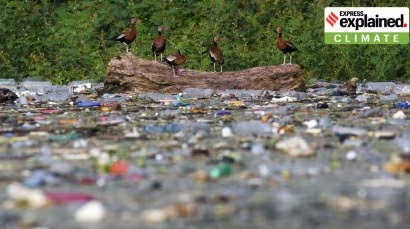
The planet’s plastic problem: why we need a global plastics treaty
- Plastic waste is everywhere, from the peak of Mount Everest to the floor of the Pacific Ocean, inside the bodies of animals and birds, and in human blood and breast milk.
- Thousands of negotiators and observers from 175 countries arrived in Ottawa, Canada, to begin talks regarding the very first global treaty to curb plastics pollution.
- The UN Environmental Assembly agreed to develop a legally binding treaty on plastics pollution by the end of 2024.
Why is a global plastics treaty needed?
- Since the 1950s, plastic production across the world has skyrocketed.
- If left unchecked, the production is slated to double by 2050, and triple by 2060.
- Although plastic is a cheap and versatile material, with a wide variety of applications, its widespread use has led to a crisis.
- Much of this plastic waste leaks into the environment, especially into rivers and oceans, where it breaks down into smaller particles (microplastic or nanoplastic).
- plastic waste is leaked to the environment; a further fraction makes its way to the ocean.
- According to a report by the Organisation for Economic Co-operation and Development (OECD), in 2019, plastics generated 1.8 billion tonnes of GHG emissions - 3.4% of global emissions.
What can the treaty entail?
- While none of the treaty’s details have currently been finalised, experts believe that it can go beyond just putting a cap on plastic production in UN member states.
- The treaty can mandate the testing of certain chemicals in plastics.
What are the roadblocks to the treaty?
- Since the first round of talks in Uruguay in November 2022, oil-producing nations like Saudi Arabia, Russia, and Iran have opposed plastic production caps, and are using myriad delay tactics (like arguing over procedural matters) to derail constructive dialogues.
- For instance, countries are yet to decide if the plastics treaty would be agreed upon by consensus or through a majority vote, according to a report published in the journal Nature.
- The US has not joined the HAC.
- “99% of plastics are derived from fossil fuels, and the fossil fuel industry continues to clutch plastics and petrochemicals as a lifeline.
- The chemical and fossil fuel industries oppose cuts to plastic production, falsely claiming that the plastics crisis is not a plastic problem, but a waste problem,” the analysis said.
- It is due to such roadblocks that the previous three rounds of negotiations have failed to make significant progress regarding the treaty.