

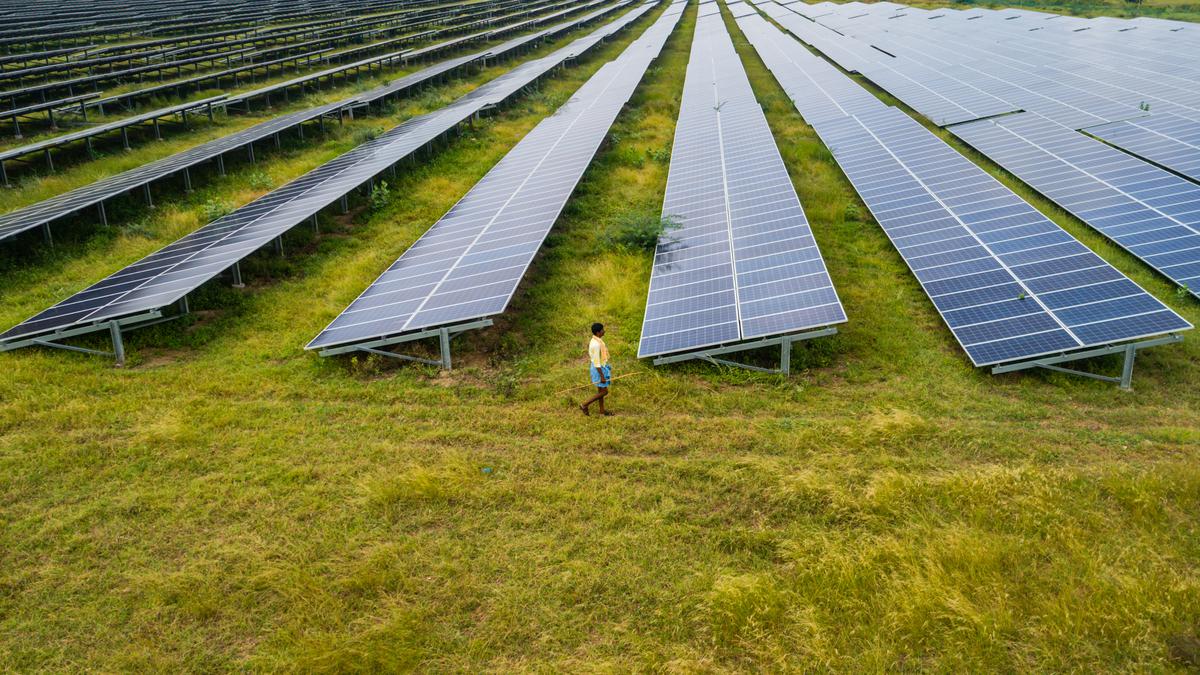
The ‘import restrictions’ on solar PV cells
- Recent government orders on attempts to increase local sourcing of solar modules to support India’s renewables manufacturing ecosystem has been widely reported as ‘import restrictions’.
- Government order to re-implement its 2021 notification of an ‘Approved List of Models and Manufacturers of Solar Photovoltaic [PV] Modules’, also called the ALMM list.
What is the ALMM list? Why is it being re-implemented?
- This list consists of manufacturers who “are eligible for use in Government Projects/Government assisted projects/ projects under Government schemes & programmes.... including projects set up for sale of electricity to the Central and State Governments.”
- However, this notification was “kept in abeyance” two years after it was issued, for the past financial year.
- While the government did not give an explicit reason for this, it stems from concerns that solar modules and cells were overwhelmingly imported from China at highly competitive rates.
- This is an import substitution effort, and not an attempt to restrict imports
Does India rely on solar PV imports?
- India is overwhelmingly import dependent to meet its demand for solar cells and modules — with China and Vietnam being the country’s major suppliers.
- “In comparison, the manufacturing capacity in India is relatively low and is largely restricted to the last manufacturing stage
- ICRA stated in its November 2023 report, adding that the PLI scheme is expected to change this, with integrated module units expected to come up in India over the next 2-3 years.
- The government also introduced a steep 40% customs duty on PV modules and 25% on PV cells.
What is the scope for solar in India?
- The government’s ambitious target of 500 GW of installed capacity from non-fossil fuels by 2030 is the main driver to scale solar power in India.
- India also accounts for the fastest rate of growth for demand of electricity through 2026 among major economies, according to the IEA.
- The country has an estimated solar power potential of 748.99 GW. Hence, the potential of solar energy is not fully tapped, so far.
- The government is making efforts to harness the available potential through various schemes & programs