

The evolving role of the Colombo Security Conclave
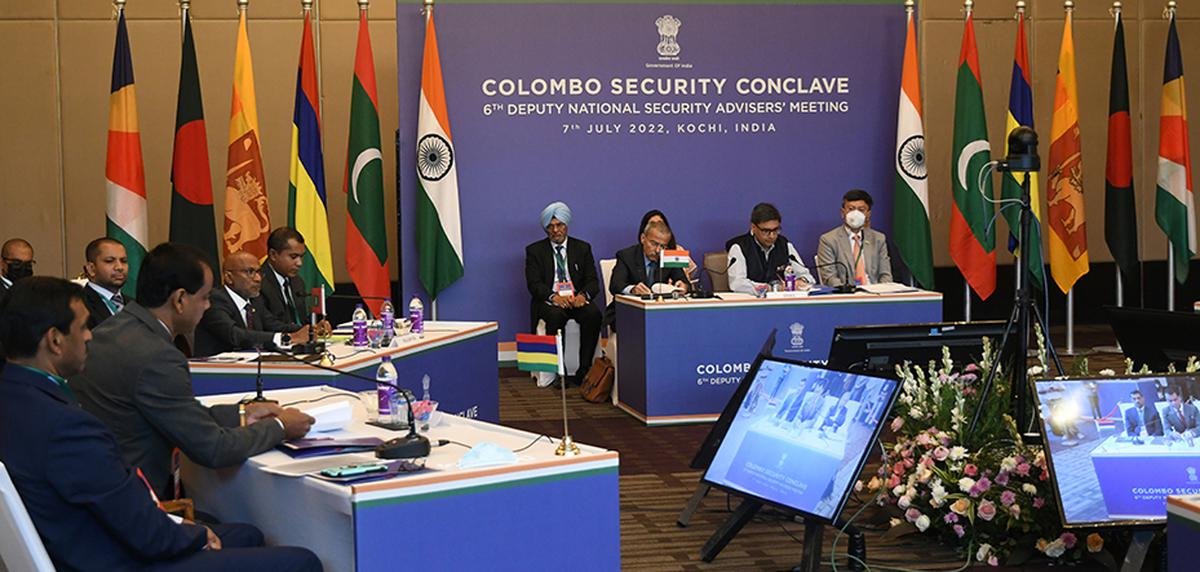
- Recently, India's National Security Advisor (NSA), participated in the sixth NSA meeting of the Colombo Security Conclave (CSC).
Evolution of CSC
- Established in 2011 with India, Maldives, and Sri Lanka for trilateral maritime security.
- It welcomed Mauritius as a fourth member at the fifth meeting of national security advisers.
- The CSC aims to promote a safe, secure, and stable Indian Ocean.
- Stalled after 2014 due to tensions between India and the Maldives.
- Revived in 2020, India proposed its expansion to Mauritius, Seychelles and Bangladesh.
- Reflects India's evolving strategic vision for the Indian Ocean amid changing dynamics.
India's Strategic Vision
- The Indian Ocean is at the heart of an evolving multipolar world today, with extra-regional powers competing for influence.
- CSC offers India an opportunity to strengthen leadership, security architecture, and address emerging threats.
- Since its independence, India has played an increasing role in promoting security in the Indian Ocean.
China's Influence
- China's Belt and Road Initiative (BRI) investments in the Indian Ocean raise security concerns.
- China aims to control sea lines of communication and limit India's influence.
- China is strengthening its naval capabilities, maintaining strong defence relationships with states in the IOR and also conducting regular maritime exercises.
- It continues to use scientific ships to map the Indian Ocean bed.
- India's strategic accommodation and flexibility is contributing to the security of the Indian Ocean.
CSC's Pillars of Cooperation
- Five Pillars: maritime security, countering terrorism, trafficking and transnational crime, cyber-security and humanitarian assistance and disaster relief (HADR).
- Since 2021, the CSC has investigated terrorism and terror financing, narcotics trafficking, cybercrime and security, marine pollution, maritime law, and coastal security.
- In 2022, for the first time, the organisation held a conference of oceanographers and hydrographers and another conference on coastal security.
Progress and Vulnerability
- The CSC, as a young institution, remains vulnerable to domestic political changes in its member-states.
- The Maldives’s absence from the recent meeting is an example of this vulnerability.
- The use of nationalist and pro-China sentiments in member-states can impact regional collaboration.
Conclusion
- Despite challenges, the CSC will remain crucial for India to help it consolidate its regional leadership.