

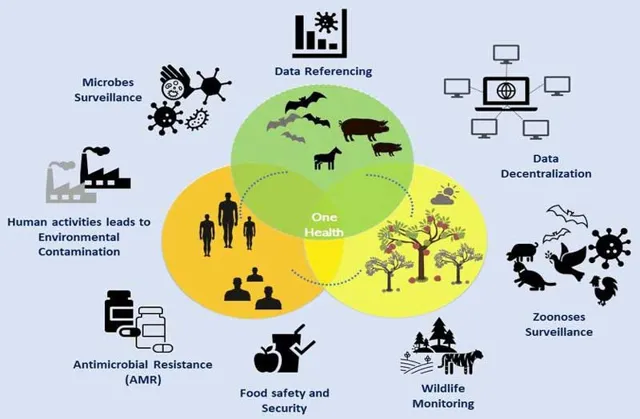
One Health Approach
Key Concepts & Definition (GS III: Environment, Health)
- Definition: "An integrated, unifying approach aiming to sustainably balance & optimize health of people, animals, & ecosystems."
- Core Principle: Recognition that human, animal (domestic/wild), plant, & environmental health are closely linked & interdependent (Hippocrates' early articulation).
- Need in India: High risk due to:
- Diverse wildlife + World's largest livestock population + High human density → Inter-compartmental disease spread risk (Zoonosis).
- Recent outbreaks: Nipah,COVID-19, Lumpy Skin Disease (Cattle), Avian Flu → Highlight need beyond just human health.
**Benefits of One Health **
- Control Zoonotic Diseases (e.g., Nipah, Avian Flu, Rabies).
- Tackle Antimicrobial Resistance (AMR).
- Ensure Food Safety & Security.
- Prevent Environment-Related Health Threats (e.g., pollution impacts).
- Protect Biodiversity & Ecosystem Health.
India's Key Initiatives (Current Affairs: Last 2-3 Years)
- National One Health Mission (2022): Endorsed by PM-STIAC. Flagship initiative.
- G-20 Endorsement (2023): Under India's Presidency → Focus on building surveillance capacity.
- Centre for One Health, Nagpur: Set up under ICMR to contain zoonoses.
- India's First One Health Consortium (Oct 2021): Launched by DBT → 27 orgs → Assesses 5 animal diseases & 10 zoonoses.
- Integrated Disease Surveillance Project (IDSP): Exists but lacks animal-environment integration (Challenge).
Major Challenges
- Coordination Silos: Weak inter-ministerial (Health, AHD, Environment) & Centre-State coordination.
- Funding & Infrastructure: Insufficient resources, lack of dedicated institutions/legal framework.
- Capacity Gaps: Low awareness (zoonotic risks), lack of epidemiology/data analytics expertise.
- Stakeholder Engagement: Limited involvement of NGOs, academia, private sector, communities.
- Institutional Will: Lack of interest among health experts, bureaucratic hurdles.
Framework for Zoonotic Outbreaks (Mains Answer Structure):
- Detection: Early diagnosis + contact tracing.
- Containment: Isolation, PPE, travel restrictions.
- Prevention: One Health (habitat conservation, livestock monitoring).
- Treatment: Supportive care + research (e.g., monoclonal antibodies trial in Kerala 2018).
--- Nipah Virus (Definition):
- Zoonotic virus (transmitted from animals to humans).
- Natural Reservoir: Fruit bats (Pteropus species).
- Transmission: Contaminated fruits (bat saliva/urine), human-to-human via bodily fluids.
- Mortality Rate: 40-75% (no cure/vaccine; management: prevention + supportive care).
- Outbreak History in India:
- 2001: West Bengal (45 deaths out of 66 cases).
- 2018: Kerala (17 deaths out of 19 cases).
- Recurring in Kerala (2019, 2021, 2023, 2025) – highlights endemic risk.
- Previous UPSC Questions:
- Mains 2021: "What are the main features of the National One Health Mission? How will it help in addressing the challenges of zoonotic diseases in India?"
- Prelims 2023: Which initiative was launched under India's G20 Presidency to enhance global health security? (Ans: One Health Framework)
- Mains 2018: "What are zoonotic diseases? Discuss the mechanisms by which zoonotic transmissions occur and suggest measures to prevent them."
- Prelims 2021: Which of the following diseases is caused by a virus and has bats as its natural reservoir? (Ans: Nipah)