

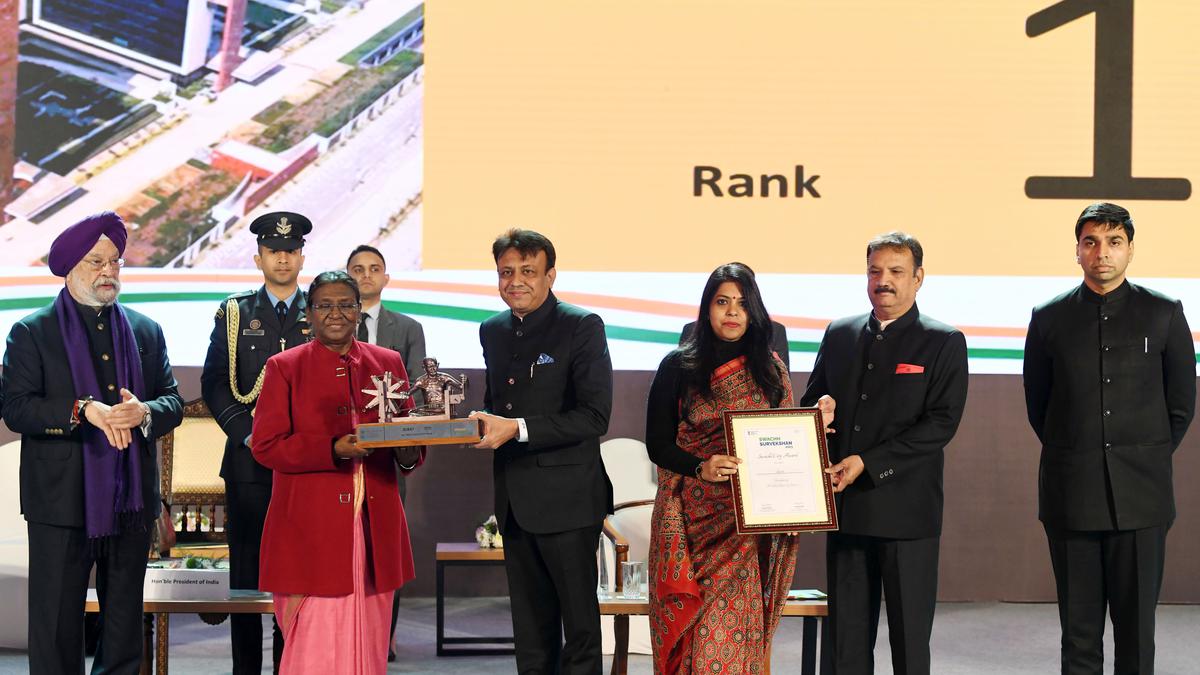
Numbers game: On the Swachh Survekshan awards
- The Centre recently announced the Swachh Survekshan Awards for the eighth year, recognizing cities, towns and states for their performance in public sanitation.
- Indore, Madhya Pradesh, has been adjudged India’s cleanest city for the seventh consecutive year, sharing honours with Surat, Gujarat.
Swachh Survekshan
- Swachh Survekshan is the world’s largest urban sanitation and cleanliness survey.
- Started in 2016 with 73 cities, the annual ranking covers 4,416 urban local bodies, 61 cantonments, and 88 Ganga towns in 2023.
- It is conducted under the ambit of the Swachh Bharat Mission (Urban).
- It was launched by the Ministry of Housing and Urban Affairs (MoHUA) with Quality Council of India (QCI) as its implementation partner.
- Objective: To encourage large-scale citizen participation and create awareness amongst all sections of society about the importance of working together toward making towns and cities better places to reside in.
- The methodology for measuring cleanliness rests on two main criterias viz. citizen feedback and field assessment.
Stagnation and Predictability
- The top-ranking cities, including Bhopal, Indore, Surat and Visakhapatnam, have remained consistent over the years, indicating a degree of stagnation.
- While some cities in the top 10 exhibit volatility, there is a lack of significant change in the leading positions.
Multiple Sub-Categories
- The survey creates multiple sub-categories, allowing more cities to score well in specific areas, such as population size.
- However, some classifications are criticised for their specificity, such as awarding the cleanest 'cantonment' town, 'Cleanest Ganga town,' and the cleanest 'Best Safaimitra Surakshit Sheher.'
Need for a Rethink in Approach
- The ranking system, aimed at motivating improvements, may not effectively address sanitation challenges influenced by historical, economic and power-related factors.
- The top-ranking cities should be excluded from future rankings to shift focus to challenges faced by other cities and encourage overall improvement.
Conclusion
- Government intervention is crucial to prevent sanitation assessments from becoming a mere numbers game.
- A reevaluation of the survey approach is needed to ensure a more meaningful assessment and sustained improvement in civic sanitation.