

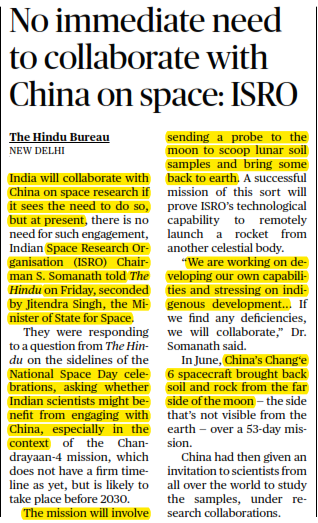
No immediate need to collaborate with China on space: ISRO
- The Chinese had invited international collaborations after their spacecraft brought back samples from the moon in June.
Highlights:
- India's space agency, the Indian Space Research Organisation (ISRO), has reaffirmed its commitment to indigenous space research and development.
- In a recent statement, ISRO Chairman S. Somanath and the Minister of State for the Department of Space, Jitendra Singh, clarified India's position on potential collaboration with China in space exploration.
- While India is open to international partnerships, there is currently no immediate need for collaboration with China, as ISRO focuses on strengthening its own capabilities.
Key Statements from ISRO and the Ministry
- ISRO's Current Focus:
- ISRO Chairman S. Somanath emphasized that India's priority is to develop its own space capabilities. He noted that while collaboration is not off the table, it would only be considered if specific deficiencies were identified in India's space research programs.
- Dr. Somanath highlighted the importance of indigenous development in achieving India's space goals, particularly in the context of upcoming missions such as Chandrayaan-4.
- Ministerial Endorsement:
- Jitendra Singh, the Minister of State for the Department of Space, echoed Dr. Somanath’s sentiments, underscoring that India has achieved significant success through its own efforts. He mentioned that while collaboration could be considered if there were mutual benefits, there is no pressing need for it at present.
- Dr. Singh also noted that India is actively engaging with other international partners, such as NASA, on various projects, showcasing India's collaborative spirit on the global stage.
- Upcoming Chandrayaan-4 Mission:
- The Chandrayaan-4 mission, which aims to send a probe to the moon to collect lunar soil samples and return them to Earth, is a key project for ISRO.
- While the mission does not have a fixed timeline, it is expected to occur before 2030. Success in this mission would further solidify India's reputation in space exploration and demonstrate ISRO's ability to remotely launch a rocket from another celestial body.
China's Invitation for Collaboration
- China's Recent Achievements:
- In June 2024, China's Chang'e 6 mission successfully brought back soil and rock samples from the far side of the moon. Following this achievement, China extended an open invitation to scientists worldwide to collaborate on the study of these samples.
- China's invitation aligns with its history of international collaboration in space exploration, having previously worked with agencies from Europe, France, Italy, and Pakistan.
- India's Position:
- Despite China's openness to collaboration, India's space leadership has chosen to maintain a cautious stance. While there is no outright rejection of potential partnerships, the emphasis remains on achieving self-reliance in space technology.
- Global Context:
- The broader context of international space cooperation includes various geopolitical considerations. For instance, U.S. law restricts direct bilateral engagement with China in space research, although American researchers have expressed interest in studying the samples returned by the Chang'e 6 mission.
Prelims Takeaways:
- NASA
- Chang'e 6