

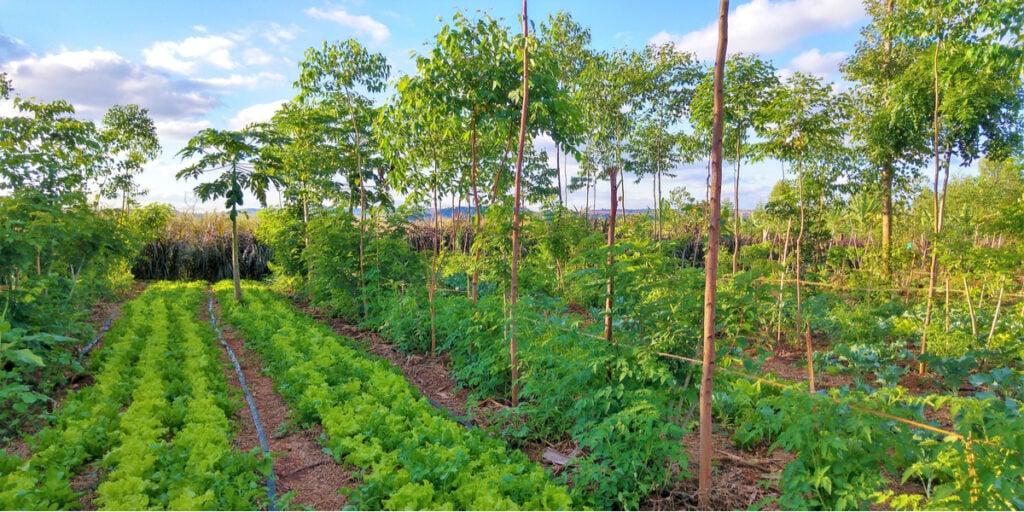
NITI Aayog Launches Greening India's Wastelands with Agroforestry (GROW) Report and Portal
- NITI Aayog unveiled the Greening and Restoration of Wasteland with Agroforestry (GROW) report and portal
- It aims to bolster efforts in environmental conservation and sustainable land use across India.
Key Highlights
- Utilising cutting-edge remote sensing and Geographic Information Systems (GIS) technologies The report offers a comprehensive state-wise and district-wise analysis
- providing crucial insights to government departments and industries engaged in greening and restoration projects.
- Under the leadership of NITI Aayog, the report employed remote sensing and GIS techniques
- To evaluate the suitability of agroforestry practices across all districts of India.
- Additionally, it introduced an Agroforestry Suitability Index (ASI) for national-level prioritization, utilizing thematic datasets.
- The GROW initiative includes the launch of the "Greening and Restoration of Wasteland with Agroforestry (GROW)-Suitability Mapping" portal on 'Bhuvan'
- Ensuring universal access to state and district-level data.
- This portal is expected to significantly boost the promotion of agroforestry initiatives by government bodies.
- Presently, agroforestry covers 8.65% of India's total geographical area, encompassing approximately 28.42 million hectares.
- The GROW report emphasizes the immense potential of converting underutilized areas, particularly wastelands, into productive agroforestry zones.
- This initiative aligns with national commitments to restore 26 million hectares of degraded land by 2030
- Establish an additional carbon sink capable of sequestering 2.5 to 3 billion tonnes of carbon dioxide equivalent.
The urgent need to promote agroforestry for three primary reasons:
- Reducing the import of wood and wood products, mitigating climate change through carbon sequestration, and optimizing the use of arable land.
- India, as the pioneer of the National Agroforestry Policy in 2014, is committed to enhancing productivity, profitability, and sustainability through agroecological land use systems.
- Agroforestry, which integrates trees, crops, and livestock, addresses multifaceted challenges related to food security, nutrition, energy, employment, and environmental conservation.
- These efforts are in alignment with global commitments such as:
- The Paris Agreement
- Bonn Challenge
- UN Sustainable Development Goals
- United Nations Convention on Combating Desertification (UNCCD)
- Doubling Farmers' Income initiative
- Green India Mission, among others.
Prelims takeaway
- United Nations Convention on Combating Desertification
- The Paris Agreement