

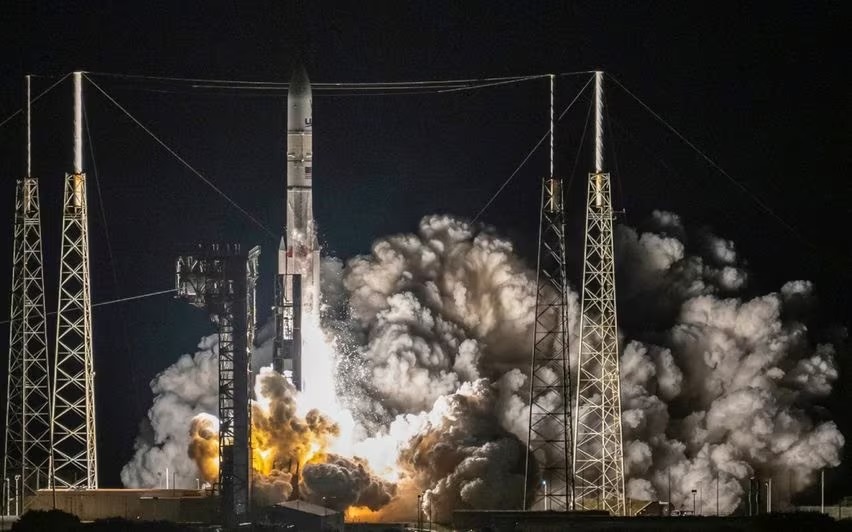
Nasa launches Peregrine lander to explore Moon's 'Bay of Stickiness'
- The Peregrine Lunar Lander was launched aboard the United Launch Alliance's Vulcan rocket to embark on its pioneering journey to explore the Moon.
Peregrine Lander
- It is designed to carry scientific instruments and other payloads to the Moon's surface, specifically targeting the Sinus Viscositatis region.
- This area, also known as the Bay of Stickiness, lies adjacent to the Gruitheisen Domes near the Oceanus Procellarum, or Ocean of Storms.
- Its objective is to locate water molecules on the moon, measure radiation and gases around the lander, and evaluate the lunar exosphere (the thin layer of gases on the moon's surface)”
Objective:
- To analyse the lunar exosphere, assess the thermal properties and hydrogen content of the lunar regolith, study magnetic fields, examine the radiation environment, and test advanced solar arrays.
- Peregrine Mission 1 will transport approximately ten payloads, with a total mass capacity of 90 kilograms.
- The scientific payload features cutting-edge instruments such as
- Laser Retro-Reflector Array (LRA)
- Linear Energy Transfer Spectrometer (LETS)
- Near-Infrared Volatile Spectrometer System (NIRVSS)
- PROSPECT Ion-Trap Mass Spectrometer (PITMS)
- Neutron SpectrometerPeregrine Lander System (NSS).
Prelims Takeaway
- PROSPECT Ion-Trap Mass Spectrometer (PITMS)
- Peregrine Mission