

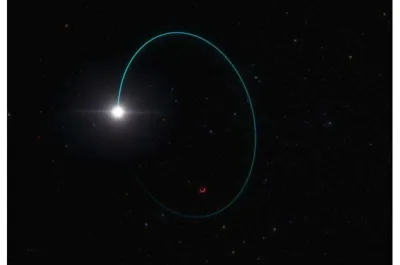
European Astronomers Discover the Largest Stellar Black Hole in the Milky Way
| Aspect | Details |
|---|---|
| Discovery | Largest stellar black hole in the Milky Way named 'BH-3'. |
| Mass | 33 times greater than the Sun. |
| Distance from Earth | 2,000 light-years. |
| Detected by | Gaia Space Observatory operated by the European Space Agency (ESA). |
| Discovery Method | Observed peculiar rotation of a star in the 'Aquila' constellation. |
| Significance | Second closest stellar black hole to Earth; largest mass of its kind in the Milky Way. |
| Common Stellar BH Mass | Around 10 times the Sun's mass. |
| Estimated BH Population | Up to one billion stellar black holes in the Milky Way. |
| Challenge in Detection | Most stellar black holes lack orbiting stars, making detection difficult. |
| Future Exploration | Advanced observatories like Gaia to study black hole formation and evolution. |