

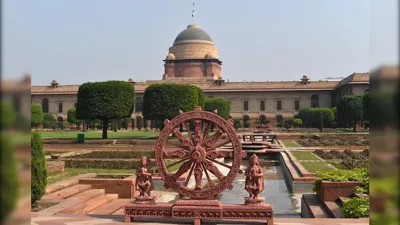
Konark Wheel Replicas Installed at Rashtrapati Bhavan to Promote Cultural Heritage
| Summary/Static | Details |
|---|---|
| Why in the news? | Four sandstone replicas of the iconic Konark wheel installed at the Rashtrapati Bhavan Cultural Centre and Amrit Udyan. |
| Objective | Promote India's rich cultural heritage to visitors. |
| Significance | - Represents India's artistic and historical legacy. - Part of integrating cultural elements into Rashtrapati Bhavan. |
| Context | - Konark Sun Temple is a UNESCO World Heritage Site in Odisha. - Temple designed as a colossal chariot for the Sun god. |
| Cultural Importance | - Symbolizes India's cultural heritage and artistic achievements. - Educates visitors about the historical significance of the temple. |
| Statement by President's Office | Replicas aim to enhance the cultural experience at Rashtrapati Bhavan, offering insights into India's traditional artistry. |
| About Konark Sun Temple | - Deity: Sun God Surya. - Location: Konark, Odisha (35 km northeast of Puri). - Constructed: Around 1250 CE by King Narasimhadeva I of the Eastern Ganga dynasty. |
| Cultural Significance | - UNESCO World Heritage Site since 1984. - Major pilgrimage site during the annual Chandrabhaga Mela in February. |
| Architectural Features | - Designed as a chariot drawn by seven horses. - 24 wheels at the base, each 9 feet 9 inches in diameter, featuring intricate carvings. |
| Konark Wheel Symbolism | - Seven horses represent days of the week. - 12 pairs of wheels symbolize months of the year. - 24 wheels signify 24 hours of a day. - Also viewed as the 'Wheel of Life' and related to Buddhism's Dharmachakra. |
| Features and Carvings | - Carvings include foliage patterns, birds, animals, and medallions with women in luxurious poses. |