

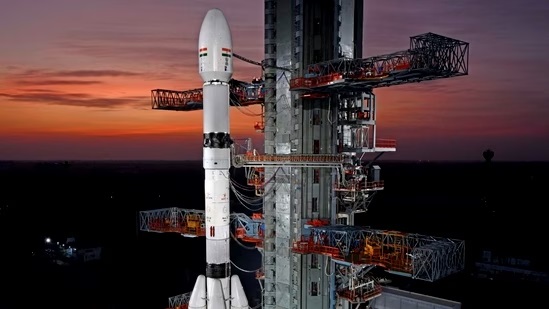
ISRO latest launch: why GSLV rocket is called 'naughty boy'
- Recently, ISRO launched the INSAT-3DS satellite to enhance monitoring of Earth's surface, atmosphere, oceans, and environment.
- It will augment the capabilities of the existing two meteorological satellites, INSAT-3D and INSAT-3DR.
- It will boost India’s weather and climate prediction services, early warnings, and disaster management services.
GSLV Rocket
- The GSLV-F14 rocket carried the satellite to geostationary orbit, boosting weather prediction and disaster management capabilities.
- GSLV is one of the three main rockets used by ISRO for carrying its satellites, the other two being PSLV and LVM3 (earlier called GSLV-MkIII).
- GSLV rocket, dubbed the 'naughty boy,' has faced challenges due to a high failure rate in previous launches.
- Out of 15 launches, four were unsuccessful, a very high failure rate for any rocket, primarily attributed to issues with the cryogenic engine.
- PSLV, the rocket that ISRO has used the maximum number of times, has failed only twice in its 60 launches.
Cryogenic Engine Challenges
- GSLV is a more powerful rocket than PSLV and can carry much heavier satellites.
- However, its problems have mainly been with the cryogenic engine that powers the third and final stage of the flight.
- GSLV's cryogenic engine, reverse-engineered from a Russian design, has posed difficulties for ISRO.
- The deal with Russia faced opposition from the United States, leading to technology transfer hurdles.
- The US claimed that it violated provisions of the Missile Technology Control Regime, an international legal framework meant to stop the proliferation of missile technology.
- The deal had to be called off. Russia did supply a few of those cryogenic engines but could not transfer the technology.
Indigenous Cryogenic Technology
- India has developed its own cryogenic engine through decades of research, closer in design to Arianne rockets.
- This indigenously developed cryogenic engine is deployed in LVM3, ISRO’s most powerful rocket so far.
- LVM3 has had seven flights till now, without any trouble.
Future Challenges and Tests
- Despite the recent successful launch, GSLV faces a crucial test with the upcoming NISAR satellite mission.
- NISAR, a collaboration between ISRO and NASA, marks a significant milestone for GSLV's capabilities.