

International collaboration of physicists demonstrates laser cooled Positronium
- An international collaboration of researchers from the Anti-hydrogen Experiment: Gravity, Interferometry, Spectroscopy (AEgIS), has achieved a significant milestone by successfully demonstrating the laser cooling of Positronium.
Positronium
- It is a fundamental atom composed of an electron (e-) and a positron (e+), both being leptons that interact through electromagnetic and weak forces.
- With a very short life, it annihilates with a half-life of 142 nanoseconds.
- It is considered a pure leptonic atom.
- Unlike usual atoms that contain a mixture of baryons and leptons, Positronium solely consists of electrons and positrons.
- Its hydrogen-like system, with halved frequencies for excitation, makes it an ideal candidate for attempting laser cooling and performing tests of fundamental physics theories.
AEgIS Initiative
- The AEgIS experiment was formally accepted by CERN in 2008, with construction and commissioning continuing through 2012-2016.
- It involves physicists from 19 European groups and one Indian group.
- Professor Sadiq Rangwala from Raman Research Institute (RRI) in Bengaluru is leading the Indian effort.
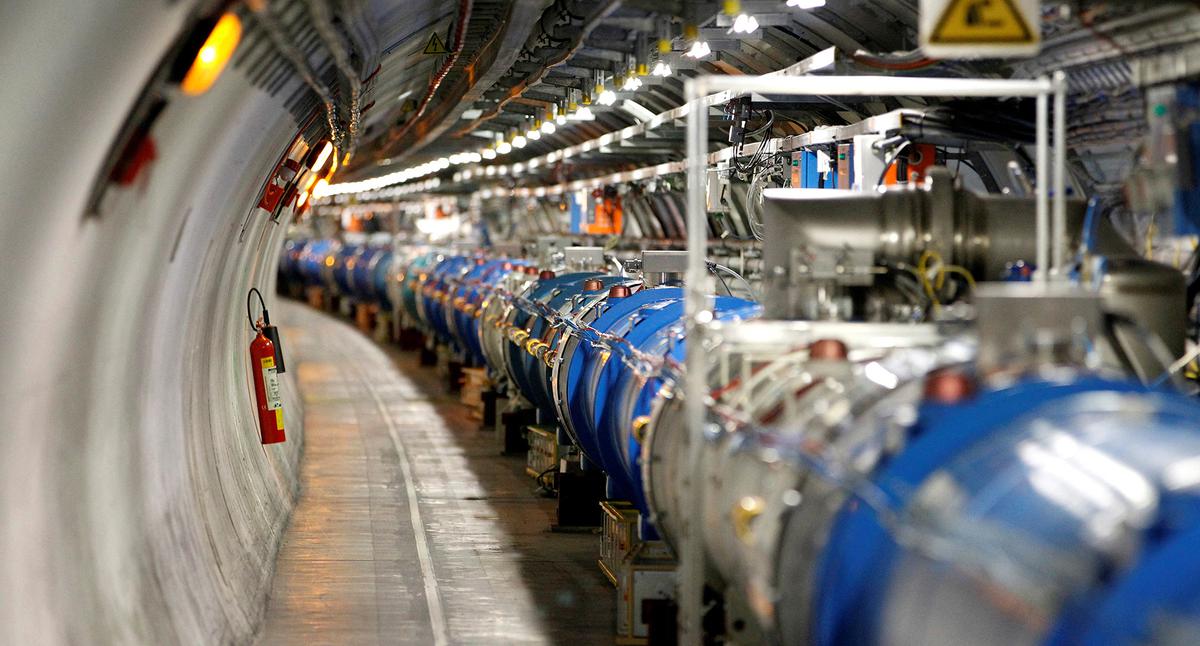
- The experiment was conducted at the European Organization for Nuclear Research (CERN) in Geneva, Switzerland.
- Significance: Serves as a crucial precursor to the formation of anti-hydrogen and the measurement of Earth’s gravitational acceleration on antihydrogen in the AEgIS experiment.
Achievements
- The AEgIS team successfully cooled Positronium atoms from ~380 Kelvin to ~170 Kelvin.
- A 70-nanosecond pulse of the alexandrite-based laser system was used to demonstrate cooling in one dimension.
- Lasers deployed were either in the deep ultraviolet or infrared frequency bands.
Future Implications
- Laser cooling of anti-atoms like Positronium and their spectroscopic comparison are crucial tests for Quantum Electro Dynamics (QED).
- This achievement opens doors for creating exotic many-particle systems like Bose-Einstein condensates.
Prelims Takeaway
- Positronium
- AEgIS Initiative