

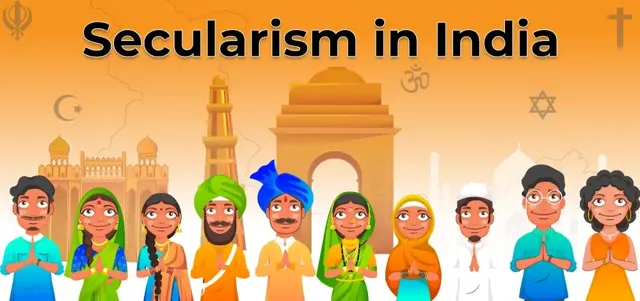
Indian Secularism: Evolution & Constitutional Framework
| Term | Definition | Indian Context |
|---|---|---|
| Secularism (India) | State neutrality + equal respect for all religions (Sarva Dharma Sambhava) | Not strict separation (France) or non-establishment (USA) |
| Constitutional Secularism | Embedded in fundamental rights (Art 14-30), directive principles | Spirit present since 1950; term added in 1976 (42nd CAA) |
| Positive Secularism | State intervention to ensure religious equality (e.g., banning discriminatory practices) | Supported by BJP historically; contrasts with passive models |
2 Historical Evolution
Pre-Constitution Roots:
- Ashoka’s Dhamma (3rd BCE):
- Rock Edict 7: Equal respect for all sects (Pasenadi Sutta analogy)
- Rock Edict 12: Condemned sectarian glorification → Proto-secular ethics
- National Movement:
- 1928: Motilal Nehru Report demanded secular state
- 1931: Karachi Resolution guaranteed religious freedom
Constitutional Journey:
- 1950: "Secular" omitted in Preamble but spirit embedded in:
- Art 14-18 (Equality), Art 25-28 (Religious Freedom), Art 29-30 (Minority Rights)
- Constituent Assembly rejected adding "In the name of God" (H.V. Kamath’s proposal)
- 1976: 42nd Amendment added "Secular" to Preamble (during Emergency)
** Philosophical Foundations**
| Thinker/Model | Key Idea | Indian Relevance |
|---|---|---|
| Nehru | Rationalist secularism; anti-dogma | Rejected politicization of religion |
| Ashoka (Rajeev Bhargava) | Dhamma as constitutional morality | Ancient roots of pluralism |
| Locke/Williams | State regulates civil interests, not souls | Basis for religious autonomy |
** Key Debates & Challenges**
- Majoritarianism vs. Pluralism:
- Risk of state appropriation of majority religion (e.g., Hindu nationalism) → Threatens minority rights
- "Western Import" Myth:
- Indigenous origins in Ashokan edicts and syncretic traditions (e.g., Sufism, Bhakti)
- 1976 Amendment Paradox:
- Term "secular" added during Emergency (suspension of rights)
Current Affairs Link:
- Ayodhya Verdict (2019): Balancing religious sentiment with secular rule of law
- Uniform Civil Code (Art 44): Secularism vs. religious personal laws
** Comparative Secular Models **
| Country | Model | Key Feature | Contrast with India |
|---|---|---|---|
| France | Laïcité | Strict religion-state separation | India allows state intervention (e.g., Haj subsidy) |
| USA | Non-establishment | "Wall of separation"; no state religion | India permits religious schools (Art 30) |
| UK | Established Church | Anglican Church; monarch as head | India has no state religion |
| Pakistan | Islamic State | Islam as state religion; limited minority rights | India constitutionally protects all faiths |