

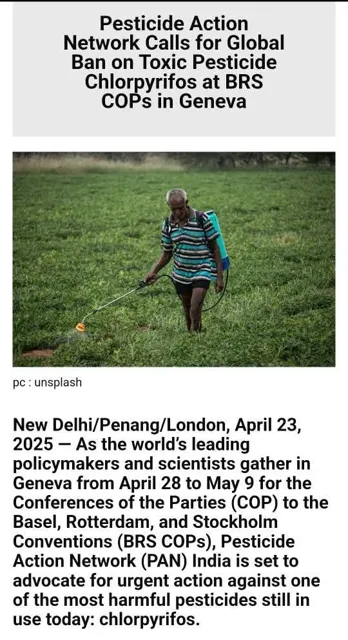
India Opposes Global Ban on Chlorpyrifos at BRS Conventions
| Category | Details |
|---|---|
| Event | India opposes global phase-out of Chlorpyrifos at the BRS Conventions meeting in Geneva (April 28 - May 9, 2025). |
| Convention Context | Stockholm Convention on Persistent Organic Pollutants (POPs) aims to eliminate or restrict chemicals harmful to health and the environment. |
| About Chlorpyrifos | • Organophosphate pesticide registered in India since 1977. • Used on rice, cotton, sugarcane, groundnut, etc. • Linked to neurological damage, cancer risks, and classified as moderately hazardous by WHO. |
| India's Stand | • Opposed inclusion in Annex A (elimination). • Cited food security concerns and lack of alternatives. • Approved for use on at least 8 crops. |
| Global Support for Ban | Supported by EU, UK, Switzerland, Norway, Uruguay, Iraq, Guyana, etc. Limited exemptions sought by Kenya and Cameroon. |
| Scientific Committee | POPs Review Committee (POPRC) recommended listing Chlorpyrifos in Annex A in 2024 due to its persistence, bioaccumulation, and long-range environmental transport. |
| Health & Environmental Risks | • Inhibits enzyme acetylcholinesterase, affecting the nervous system. • Most detected pesticide in 2024 food contamination study in India (33% detection frequency). |
| Background | • Over 40 countries have banned Chlorpyrifos. • India and China are the largest producers. • India previously opposed banning endosulfan in 2010. |
| Stockholm Convention | Adopted in 2001, effective from 2004. Lists chemicals in Annex A (elimination), Annex B (restriction), Annex C (unintentional production minimization). |
| Other Chemicals Discussed | Medium-chain chlorinated paraffins, long-chain perfluorocarboxylic acids (LC-PFCAs). |