

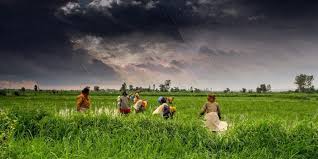
Ignoring an agricultural sector in distress
- The Finance Ministry's report and the vote-on-account by the Finance Minister are focusing more on projecting a positive image of the government than addressing the financing plans for 2024-25.
- The primary concern is whether the distress in agriculture over the past decade has improved or worsened.
Marginal Increase in Allocations
- The allocations to agriculture, fisheries, and animal husbandry have seen a marginal increase.
- However, official data suggests a decline in the sectoral deflator in agriculture, indicating a squeeze on farmers' incomes.
Incomes and Profitability
- Agricultural prices experienced a strong downward pull, affecting farmers' incomes.
- Minimum support prices (MSP) did not rise adequately, impacting the government's ability to control prices in the market.
- For major foodgrain crops, the MSPs rose by an average of 8-9% per annum between 2003-04 and 2012-13, but only by about 5% between 2013-14 and 2023-24.
- Real incomes of farmers fell, accompanied by a rise in rural unemployment and a crowding of the agricultural sector.
- For rural men, the rise in unemployment was from 1.7% to 5.6%. For rural women, the rise was from 1.7% to 3.5%.
- The promise to double the real incomes of farmers by 2022 seems to have disappeared in recent years.
Stagnant Rural Wages and Public Investment
- Real wages in rural India have not risen since 2016-17 and have even fallen after 2020-21.
- These trends have been true for agricultural wages and non-agricultural wages in the rural areas.
- The public investment in agriculture, including research and extension, remained stagnant or fell over the past decade.
- Capital investment in agricultural sectors did not rise, contributing to the overall stress in rural India.
Painting a Rosy Picture
- The Finance Ministry's report and Budget speech present a different narrative, emphasizing absolute numbers on increases in agricultural production.
- However, they overlook the long-term decline in agricultural growth since the early 2010s.
- The index numbers of production of all principal crops grew by 3.1% annually between 2003-04 and 2010-11, but only by 2.7% annually between 2011-12 and 2022-23.
Budget Estimates for 2024-25
- The Budget Estimates for 2024-25 do not inspire confidence, lacking substantive measures to reverse the decline in agricultural growth.
- Key heads and flagship schemes in agriculture and allied sectors face spending cuts, including fertiliser and food subsidies, Pradhan Mantri Gram Sadak Yojana, and MGNREGS.
- The budgeted allocations for the fisheries sector and animal husbandry show minimal increases.