

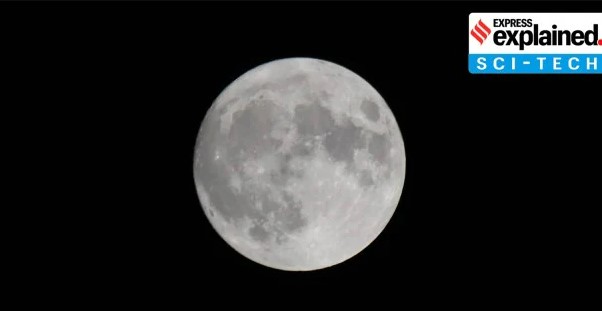
How and why US wants to establish a time standard for the Moon
- Last week, the US White House officially directed the National Aeronautics and Space Administration (NASA) to create a time standard for the Moon, which different international bodies and private companies can use to coordinate their activities on the lunar surface.
how does Earth’s time standard work?
- Most of the clocks and time zones — a geographical region which uses the same standard time — of the world are based on Coordinated Universal Time (UTC)
- which is set by the International Bureau of Weights and Measures in Paris, France.
- It is tracked by a weighted average of more than 400 atomic clocks placed in different parts of the globe.
- Atomic clocks measure time in terms of the resonant frequencies — the natural frequency of an object where it tends to vibrate at a higher amplitude — of atoms such as cesium-133.
- In atomic time, a second is defined as the period in which a caesium atom vibrates 9,192,631,770 times.
- As the vibration rates at which atoms absorb energy are highly stable and ultra-accurate, atomic clocks make for an excellent device for gauging the passage of time.
- To obtain their local time, countries need to subtract or add a certain number of hours from UTC depending on how many time zones they are away from 0 degree longitude meridian, also known as the Greenwich meridian.
- If a country lies on the west of the Greenwich meridian, it has to subtract from the UTC, and if a country is located on the east of the meridian
Why do we need a time standard for the Moon?
- UTC, however, cannot be used to determine time on the Moon.
- That is because time on the Moon flows differently than it does on the Earth.
- In other words, for someone on the Moon, an Earth-based clock will appear to lose on average 58.7 microseconds per Earth day with “additional periodic variations”, according to the OSTP memo.
- Several countries, including India, are looking to populate the Moon in the following years.
- While NASA’s Artemis program aims to send astronauts back to the lunar surface no earlier than September 2026
- China has announced plans to land its astronauts by 2030, and India intends to arrive by 2040.
- There are also proposals to build a long-term human outpost on the Moon. Therefore, there is a need for a unified lunar time standard.
Prelims takeaway
- GMT
- NASA