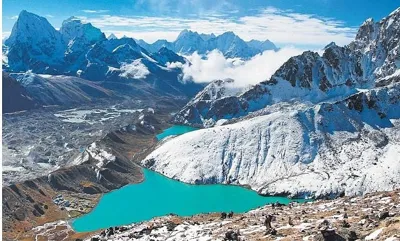
| Why in the news? | A government report indicated that glacial lakes in the Himalayan region have experienced a 10.81% increase in area from 2011 to 2024, primarily due to climate change. The report highlights a significant risk of Glacial Lake Outburst Floods (GLOFs). |
| Key Findings | - Indian Lakes Expansion: The total area of glacial lakes in India grew from 1,962 hectares in 2011 to 2,623 hectares in 2024, marking a 33.7% increase.- High-Risk Lakes: 67 lakes in India experienced over 40% increase in surface area, categorizing them as high-risk for GLOFs.- Regional Expansions: Notable expansions were recorded in Ladakh, Himachal Pradesh, Uttarakhand, Sikkim, and Arunachal Pradesh.- Himalayan Region: Overall, glacial lakes across the Himalayan region increased from 533,401 hectares in 2011 to 591,108 hectares in 2024. |
| Impacts of Climate Change | - Melting Glaciers: Accelerated melting of glaciers due to rising temperatures.- GLOF Risks: Increased risk of Glacial Lake Outburst Floods (GLOFs), which can lead to sudden and catastrophic floods. |
| Technological Advancements | - Satellite Technology: Use of Sentinel-1 Synthetic Aperture Radar (SAR) and Sentinel-2 Multispectral Imagery for precise monitoring of lake sizes with 10-meter accuracy, even under challenging conditions like cloud cover.- Transboundary Risks: Emphasis on collaboration with neighboring countries (Bhutan, Nepal, and China) for effective management of GLOFs. |
| Recommendations | - Development of robust early warning systems.- Promotion of awareness among local populations.- Improvement of disaster management plans through international and regional cooperation. |
| Implications for Water Availability | - Potential impact on water availability in major river systems (Ganga, Brahmaputra, and Indus).- Use of data comparisons from 2011 and five to ten-year averages for targeted risk assessments. |
| About Glacial Lakes/GLOFs | - Glacial lakes are formed by meltwater from receding glaciers, often dammed by unstable ice or sediment.- GLOFs occur when these natural dams fail, leading to sudden and catastrophic floods.- Triggers for GLOFs include glacial calving, avalanches, or landslides. |
| Central Water Commission HQ | New Delhi |
| CWC Chairman | Shri Kushvinder Vohra |