

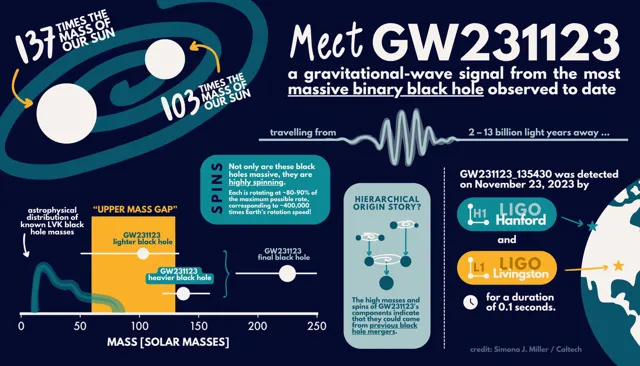
** GW231123 gravitational wave **
Detection Network: LVK Collaboration (LIGO-USA, Virgo-Italy, KAGRA-Japan)
Source: Merger of two intermediate-mass black holes (IMBHs) ~10 billion years ago.
Mass Scale:
- Black Hole 1: 140 solar masses
- Black Hole 2: 100 solar masses
- Merged Black Hole: 225 solar masses (heaviest IMBH merger detected)
1. Gravitational Waves (GW)
- Definition: Ripples in space-time fabric caused by cosmic cataclysms (e.g., black hole mergers).
- Prediction: Einstein’s General Relativity (1916); first detected in 2015 (GW150914).
- Significance: Opens a new window to observe "dark" cosmic events (no light emitted).
2. Black Hole Classification
| Type | Mass Range | Example |
|---|---|---|
| Stellar-mass | 5–100 solar masses | Collapsed stars |
| Intermediate (IMBH) | 100–10,000 solar masses | GW231123 components |
| Supermassive | Millions–billions solar masses | Sagittarius A* (Milky Way center) |
Why GW231123 Matters:
- Rare evidence of IMBH formation (theoretical gap between stellar & supermassive BHs).
- Validates models of hierarchical galaxy growth (mergers build larger BHs).
Gravitational Wave Observatories
| Observatory | Location | Key Features |
|---|---|---|
| LIGO | Hanford (WA) & Livingston (LA), USA | Funded by NSF; world's largest GW detector |
| Virgo | Pisa, Italy | Joint project of Italy & France (EGO) |
| KAGRA | Kamioka mine, Japan | World's first underground GW observatory |
| LIGO-India | Hingoli, Maharashtra | Upcoming (2026); boosts global detection accuracy |