

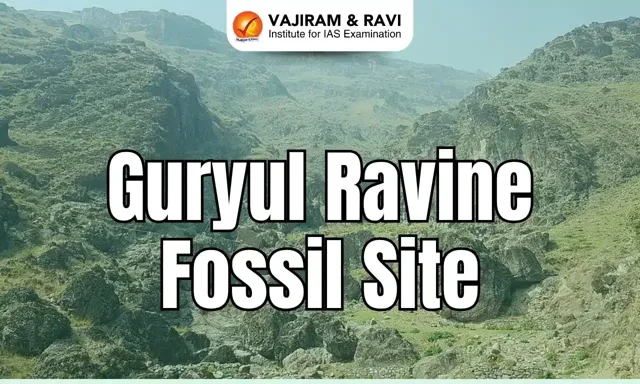
Guryul Ravine The Geological Survey of India (GSI) has issued a stark warning to the Jammu and Kashmir administration over a “serious threat” to the important Guryul Ravine fossil site in Khonmoh, on the outskirts of Srinagar
| Aspect | Details |
|---|---|
| Location | Khonmoh, Srinagar outskirts (J&K); near Dachigam NP & Khonmoh Conservation Reserve |
| Geological Significance | Global Stratotype Section (GSSP candidate): Records Earth’s largest mass extinction |
| Time Span | 260–251 million years (Permian-Triassic boundary) |
| Key Evidence | - Permian-Triassic Extinction ("Great Dying"): 96% marine species loss - World’s oldest tsunami deposit (visible in rock layers) |
Permian-Triassic Extinction ("Great Dying")
- Timeline: ~252 million years ago (Paleozoic-Mesozoic boundary).
- Impact: Worst extinction event in Earth’s history – wiped out 96% marine species and 70% terrestrial vertebrates.
- Causes:
- Volcanic eruptions (Siberian Traps, releasing CO₂/SO₂).
- Ocean anoxia, acid rain, global warming.
- Guryul’s Role: Fossil layers show abrupt species disappearance → key to studying climate change impacts.