| Publisher | Institute for Economics & Peace (IEP) |
| Number of Countries Assessed | 163 independent states and territories |
| Global Peace Trend | Average peacefulness deteriorated by 0.56% in 2024 (5th consecutive year of decline) |
| Countries with Improvements | 65 countries improved in peacefulness |
| Countries with Deteriorations | 97 countries experienced deteriorations (highest since GPI inception) |
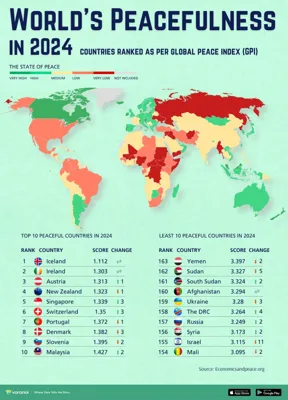
| Most Peaceful Countries | 1. Iceland, 2. Ireland, 3. Austria, 4. New Zealand, 5. Singapore |
| Least Peaceful Countries | 1. Yemen, 2. Sudan, 3. South Sudan, 4. Afghanistan, 5. Ukraine |
| Most Peaceful Region | Europe |
| Least Peaceful Region | Middle East and North Africa (MENA) |
| Largest Regional Deterioration | North America |
| Militarisation Trends | Largest year-on-year deterioration; military expenditure (% of GDP) increased in 86 countries |
| Ongoing Conflict Trends | Significant deterioration due to wars in Gaza and Ukraine |
| Safety and Security Trends | Slight improvement; reductions in violent demonstrations, terrorism impact, homicide rate |
| Economic Impact of Violence | $19.1 trillion (13.5% of global GDP or $2,380 per person) |
| Conflict Costs | Ukraine's economy shrank by 30% in 2022; Syria's GDP dropped 85% since civil war onset |
| Military and Security Spending | 74% of economic impact attributed to military and security spending ($8.4 trillion) |
| Changing Nature of Conflict | Rise of asymmetric warfare, technological advancements, and internationalised conflicts |
| Positive Peace | Focus on attitudes, institutions, and structures that sustain peaceful societies |
| Halo Approach | IEP's framework for analyzing societal systems and designing resilience-building programs |