

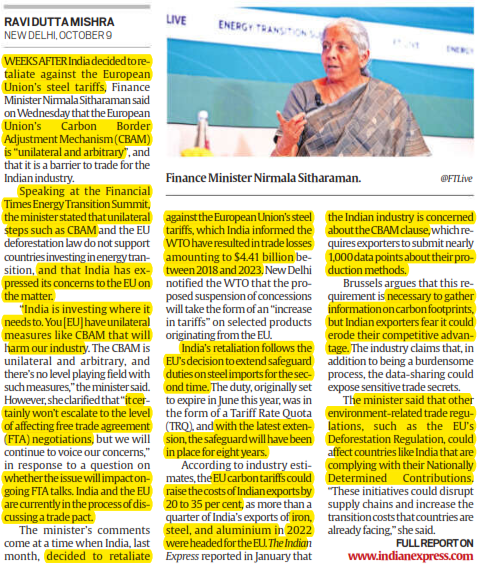
European Union's carbon tax is arbitrary, a barrier to trade: FM Sitharaman
- Finance Minister Nirmala Sitharaman said on Wednesday that the European Union’s Carbon Border Adjustment Mechanism (CBAM) is “unilateral and arbitrary”, and that it is a barrier to trade for the Indian industry.
Highlights:
- India’s Finance Minister Nirmala Sitharaman has criticized the European Union's Carbon Border Adjustment Mechanism (CBAM), labeling it as "unilateral and arbitrary." At the Financial Times Energy Transition Summit, Sitharaman emphasized that such measures pose trade barriers for the Indian industry and hamper global energy transition efforts.
Concerns Over CBAM and EU Deforestation Law
- CBAM’s Impact on Trade:
- The CBAM, which imposes carbon tariffs on imports from countries with lower environmental standards, has sparked concerns in India. Sitharaman highlighted that these unilateral measures would disproportionately harm Indian industries, particularly in sectors like iron, steel, and aluminum.
- She warned that the mechanism creates an uneven playing field, making it harder for India to compete in European markets.
- EU Deforestation Law:
- India also raised concerns over the EU’s deforestation law, which requires stringent compliance measures from exporting nations. These environmental regulations could further disrupt supply chains and increase the costs associated with energy transition.
- Notably, pushback from several countries, including India, led the European Commission to delay the implementation of the EU Deforestation Regulation by a year.
India’s Retaliation to EU Steel Tariffs:
- India’s concerns about the CBAM come on the heels of its decision to retaliate against the EU’s extended steel tariffs. India notified the World Trade Organization (WTO) that it plans to raise tariffs on selected EU products in response to trade losses of $4.41 billion caused by these tariffs between 2018 and 2023.
- These duties, initially set to expire in 2023, were extended for a second time, further straining trade relations between India and the EU.
Financial Impact on Indian Exports:
- The imposition of carbon tariffs under CBAM could raise the cost of Indian exports to the EU by 20-35%. Given that more than a quarter of India’s exports of iron, steel, and aluminum in 2022 were destined for the EU, the increased costs could erode India's competitive edge.
- The Indian industry is particularly concerned about the CBAM’s data-sharing requirements, which demand the submission of nearly 1,000 data points on production methods, potentially exposing sensitive trade secrets.
Energy Transition Efforts in India:
- Despite these challenges, Sitharaman underscored India’s continued commitment to green transition. She pointed to various government initiatives, such as the Production Linked Incentive (PLI) scheme, which promotes growth in 13 "sunrise sectors," including green energy and hydrogen missions.
- Additionally, India is advancing household energy sustainability through schemes like the PM Surya Ghar Muft Bijli Yojana.
- The Finance Minister reassured that India is on track to meet its long-term climate goals, particularly the 2030 and 2070 targets for reducing carbon emissions. She also emphasized the availability of blended finance options to fund green projects, suggesting a favorable environment for achieving these objectives.
Prelims Takeaways:
- European Union’s Carbon Border Adjustment Mechanism (CBAM)
- Tariff Rate Quota (TRQ)
- Nationally Determined Contributions (NDCs)