

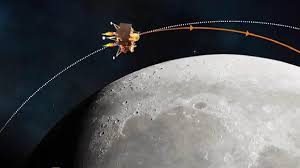
Chandrayaan-3 lander on the moon successfully pinged by orbiting NASA spacecraft using laser
- NASA's Lunar Reconnaissance Orbiter (LRO) successfully transmitted and reflected laser beams between itself and India's Chandrayaan-3 lander on the moon.
- Objective: To precisely locate targets on the lunar surface, opening possibilities for future missions.
NASA's Laser Experiment
- NASA LRO's laser altimeter instrument sent laser pulses toward Vikram lander of Chandrayaan-3.
- After detecting light bounced back from a retroreflector on Vikram lander, NASA confirmed the success of the experiment.
- The technique involves sending laser pulses towards an object and measuring the time it takes for light to bounce back, commonly used for tracking Earth-orbiting satellites.
Future Improvements and Applications
- NASA aims to improve the technique to make it routine for missions using retroreflectors in the future.
- The techniques need to be refined for broader applications.
International Cooperation
- NASA’s Laser Retroreflector Array (LRA) was accommodated on the Vikram lander under international collaboration between NASA and ISRO.
- It comprises eight corner-cube retroreflectors on a hemispherical support structure designed to last for decades on the lunar surface.
- While several LRAs have been deployed on the moon, the LRA on Chandrayaan-3 is a miniature version and is the only one available near the south pole.
Significance
- NASA's LRA on Chandrayaan-3 will serve as a long-term geodetic station and location marker, aiding in precise determination of the spacecraft's orbital position.
- It will contribute to refining the lunar geodetic frame, providing insights into the moon's dynamics, internal structure, and gravitational anomalies.
- The success of the laser experiment marks progress in collaboration between NASA and ISRO, contributing to lunar exploration and future missions.
Prelims Takeaway
- NASA's Lunar Reconnaissance Orbiter (LRO)
- Chandrayaan 3
- Laser Retroreflector Array (LRA)