

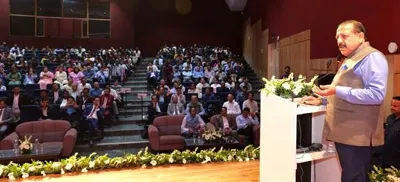
Asia's First Pre-Clinical Network Facility Established for Epidemic Preparedness
| Aspect | Details |
|---|---|
| Event | Establishment of Asia's first pre-clinical network facility for health research. |
| Location | Regional Centre of Biotechnology, Faridabad, Haryana. |
| Institution | Translational Health Science & Technology Institute (THSTI). |
| Initiative | Part of the Coalition of Epidemic Preparedness Innovations (CEPI). |
| Key Features | - Capability to handle BSL3 pathogens. - 9th network laboratory globally, first in Asia. - Houses 75,000 mice, immune-compromised mice, rats, rabbits, hamsters, and guinea pigs. - Includes "Genetically Defined Human Associated Microbial Culture Collection (Ge-HuMic) Facility." |
| Ge-HuMic Facility | - Acts as a repository for microbial cultures. - Functions as a Nodal Resource Center for collaborations. - Stores genetically characterized specific pathogen-free animals, including cryopreserved embryos and sperm. |
| CEPI | - Global partnership launched in 2017 in Davos, Switzerland. - Founded by Norway, India, Bill & Melinda Gates Foundation, Wellcome Trust, and World Economic Forum. - Aims to develop vaccines to stop future epidemics. |
| IndCEPI Mission | Implemented by Department of Biotechnology, Ministry of Science & Technology, Government of India. Objectives align with CEPI to strengthen vaccine development for diseases of epidemic potential in India. |
| THSTI | - Autonomous institute of the Department of Biotechnology (DBT). - Located in Faridabad, Haryana. |
| Biosafety Levels (BSL) | - Categorizes protective measures in laboratories. - Four levels: BSL-1, BSL-2, BSL-3, and BSL-4, with BSL-4 being the highest level of containment. |