

Aditya-L1 reaches destination, in orbit around L1
- ISRO has achieved a significant milestone as the Aditya-L1 spacecraft reached its destination, the Lagrangian point L1 recently.
- This solar mission marks India's first observatory dedicated to studying the sun.
Aditya-L1 Mission
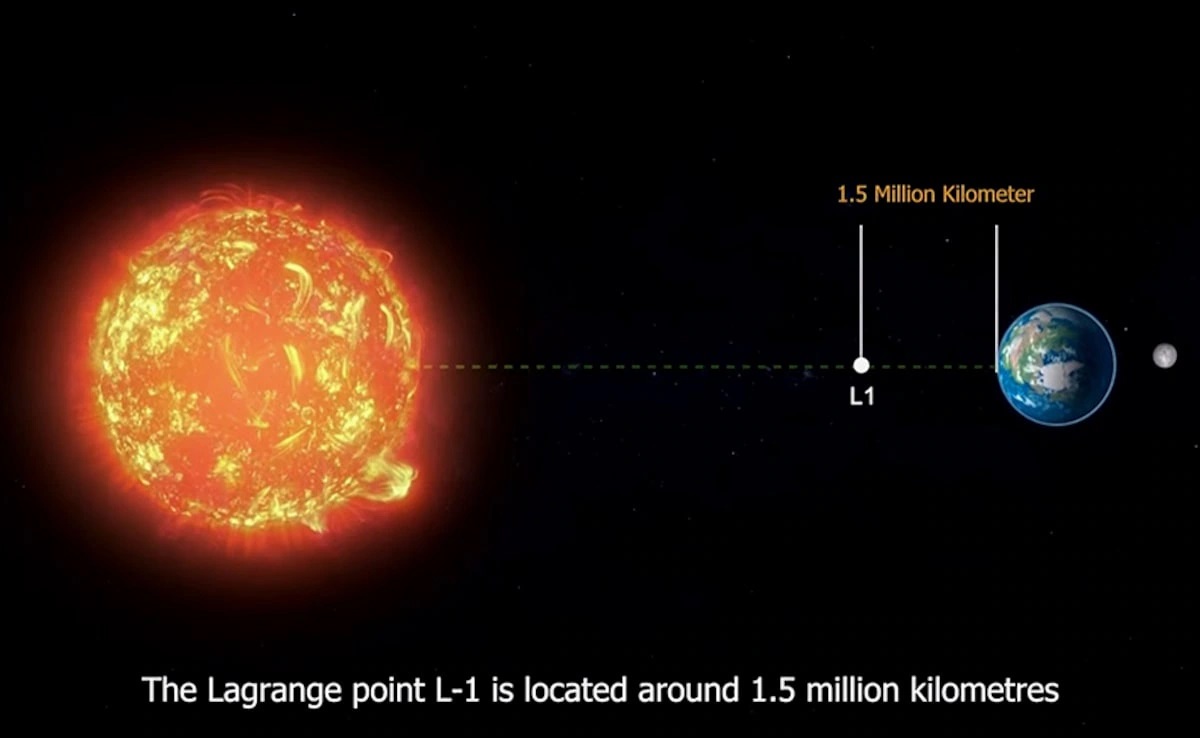
- Launched by ISRO to the L1 orbit which is about 1.5 million km from the Earth.
- Objectives
- To study the Sun’s corona, Sun's photosphere, chromosphere, solar emissions, solar winds and flares and Coronal Mass Ejections (CMEs).
- To carry out round-the-clock imaging of the Sun without occultation, providing vital information on solar activities.
- Mission Lifetime: 5 years
Launch Vehicle and Payloads
- Launched using the Polar Satellite Launch Vehicle (PSLV)
- PSLV also launched the Chandrayaan-1 (2008) and the Mars Orbiter spacecraft (2013).
- Seven payloads on board viz.
- Visible Emission Line Coronagraph (VELC)
- Solar Ultraviolet Imaging Telescope (SUIT)
- Solar Low Energy X-ray Spectrometer (SoLEXS)
- Aditya Solar wind Particle Experiment (ASPEX)
- High Energy L1 Orbiting X-ray Spectrometer (HEL1OS)
- Plasma Analyser Package for Aditya (PAPA)
- Advanced Tri-axial High Resolution Digital Magnetometers
- The L1 allows four payloads to directly view the sun, while three payloads conduct in-situ studies of particles and fields at the L1 point.
Future Prospects
- Aditya-L1's observations will provide crucial information on coronal heating, coronal mass ejections, flare activities, space weather dynamics, and particle and field propagation.
- The satellite is expected to spend its entire mission life orbiting around L1, contributing to a deeper understanding of solar phenomena.
Lagrange Points
- Lagrange Points are positions in space where a small object tends to stay in a two-body gravitational system.
- These points in space can be used by the spacecraft to remain at these positions with reduced fuel consumption.
- For two-body gravitational systems, there are a total of five Lagrange points, denoted as L1, L2, L3, L4 and L5.
L1 Point
- The L1 point lies between the Sun-Earth line, approximately 1.5 million km from Earth.
- The distance of L1 from earth is approximately 1% of the earth-sun distance.
- This provides a unique advantage for continuous solar observations without occultation or eclipse.
- Currently, four operational spacecraft are positioned at L1, contributing to solar and heliospheric studies.
- These include WIND, Solar and Heliospheric Observatory (SOHO), Advanced Composition Explorer (ACE) and Deep Space Climate Observatory (DSCOVER).
Prelims Takeaway
- Aditya L1 Mission
- Lagrange Points