

A Hint of Hope
- India and its Neighborhood- Relations.
Context:
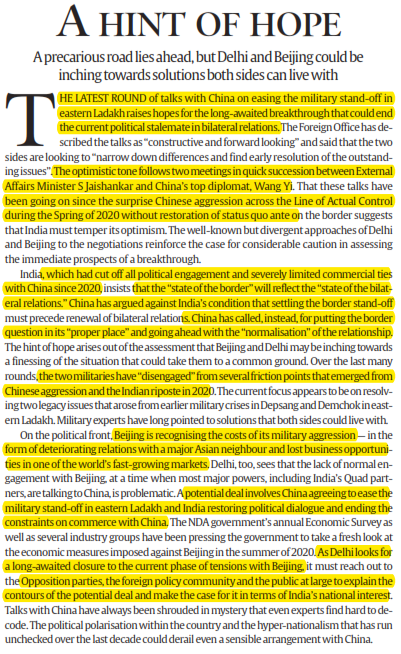
- The recent dialogue between India and China, aimed at resolving the military stand-off in eastern Ladakh, brings a glimmer of hope for a breakthrough that could end the prolonged political deadlock between the two Asian giants.
- The "constructive and forward-looking" tone adopted by both sides, as described by the Indian Foreign Office, marks a cautious optimism.
- However, given the history of the conflict and the divergent approaches of Delhi and Beijing, India must balance its optimism with a realistic assessment of the challenges ahead.
- Background: Since the surprise Chinese aggression across the Line of Actual Control (LAC) in the spring of 2020, India and China have been engaged in a series of talks to restore peace and normalcy at the border.
- India's firm stance has been that the "state of the border" will directly impact the "state of bilateral relations." This position underscores India's insistence that the resolution of the border stand-off is a prerequisite for any normalization of relations with China.
- Conversely, China has advocated for compartmentalizing the border issue and proceeding with the normalization of broader bilateral ties.
- This fundamental difference in approach has been a significant obstacle in the negotiations, making the prospects of a swift resolution uncertain.
- The Current State of Affairs: Despite these challenges, there are signs that both nations may be inching closer to a compromise. The recent disengagement from several friction points along the LAC, following the 2020 clashes, reflects a gradual de-escalation.
- The current focus appears to be on resolving long-standing issues in Depsang and Demchok, where military experts have suggested feasible solutions that could be acceptable to both sides.
- On the political front, there is growing recognition in Beijing of the costs associated with its aggressive posture—deteriorating relations with a key neighbor and the loss of economic opportunities in one of the world's fastest-growing markets.
- For Delhi, the lack of normal engagement with Beijing, especially when other major powers, including India’s Quad partners, are interacting with China, is increasingly untenable.
- Towards a Potential Deal: A potential deal on the horizon involves a mutual agreement where China eases the military stand-off in eastern Ladakh, and India, in turn, restores political dialogue and lifts some of the economic constraints imposed since 2020.
- This would be a significant shift in India’s policy, as the NDA government has been under pressure from its annual Economic Survey and industry groups to reconsider the stringent measures against Beijing.
- However, any such deal must be approached with careful deliberation. The stakes are high, and the repercussions of missteps could be severe, both domestically and in the broader geopolitical context.
- The Need for Political Consensus: For India, the path to a sustainable resolution with China must involve broad-based political consensus. The government needs to engage with Opposition parties, the foreign policy community, and the public to clearly explain the contours of any potential agreement. Transparent communication is crucial to avoid misunderstandings and to build a united front in pursuing India’s national interest.
- The complex nature of India-China relations, combined with the political polarization and rising hyper-nationalism within the country, could complicate efforts to reach a sensible arrangement with China.
- Therefore, it is imperative for the government to navigate these internal dynamics carefully while pursuing diplomatic engagements with Beijing.